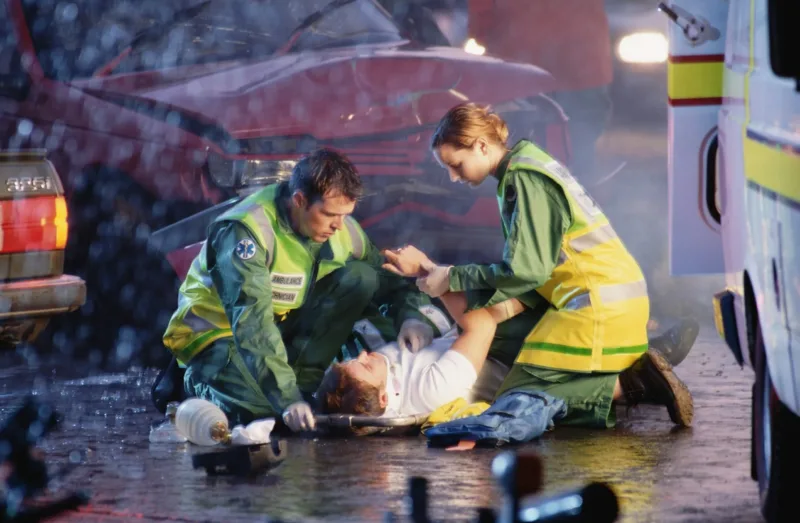
Car Accident Legal Help:Insurance Claims, Settlement Strategy, and Maximum Recovery
Vikk AI provides instant, state-specific car accident guidance for all 50 U.S. states. It explains the claim process for both no-fault and at-fault states, common injury types and their typical settlement ranges, insurance company tactics, and drafts your demand letter and negotiation responses. Free to start. No credit card required.
Car accidents are the most common source of personal injury claims, accounting for the majority of all civil litigation in the United States.
Insurance companies typically begin building defenses to your claim before you have even completed treatment. Whether you have just been in an accident, you are dealing with insurance company tactics, you are evaluating a settlement offer, you are preparing for a deposition, or you are dealing with the long-term consequences of injuries, Vikk AI is your always-available legal research, claim preparation, and document drafting partner. Vikk AI does not replace a personal injury attorney for serious injury cases. For catastrophic or significant injuries, retained representation typically produces substantially higher net recoveries even after contingency fees. What Vikk AI does is help you evaluate your case before signing with any attorney, prepare effectively for representation, and understand insurance company tactics. For minor accidents with limited injuries, Vikk AI can often handle the entire claim and save the contingency percentage. Ask any question about your accident, your state's insurance framework, common injury types and their settlement ranges, the police report process, evidence preservation, dealing with insurance adjusters, and how to evaluate offers. Upload accident reports, medical records, vehicle damage photos, insurance correspondence, and any other documents and Vikk AI analyzes everything in plain English. Draft demand letters, claim documentation, settlement responses, and consultation preparation packages in minutes. When the case requires legal representation, Vikk AI suggests verified personal injury attorneys in your area or you can browse the directory yourself.
What should I do immediately after a car accident?
The first hours after an accident substantially affect your case. Specific steps to take below.
Move to a safe location if possible. Call 911 to report any injuries and request police response. Police reports are central evidence in most car accident cases.
Adrenaline masks injuries. Many serious injuries (whiplash, concussion, internal injuries) are not immediately apparent. Medical examination and documentation in the immediate aftermath is essential. Insurance companies use any delay in medical treatment to argue injuries are not real or are unrelated.
Get the other driver's name, address, phone number, license number, insurance information, vehicle registration, and license plate. Provide the same information to them. Take photos of their license, insurance card, and vehicle.
Photographs of all vehicles from multiple angles, the position of vehicles before they are moved, the surrounding area (traffic signs, signals, road conditions), any visible injuries, and the other driver's vehicle damage. Video can capture the broader scene.
Bystanders who witnessed the accident often provide critical evidence. Get their names and contact information. Witnesses are difficult to locate later if you do not get their information immediately.
Provide your account to investigating officers but avoid speculation, admissions of fault, or extensive narratives. Stick to facts you directly observed. Anything you say can appear on the police report.
Report the accident to your insurance company within the timeframes required by your policy (typically 24 to 72 hours). Provide basic facts only; do not speculate about fault, do not minimize injuries, and do not give a recorded statement without preparation.
The at-fault driver's insurance company will request a recorded statement, often within days of the accident. Decline politely. Statements made before injuries are fully diagnosed can damage your case. Use Vikk AI or attorney consultation before any recorded statement.
What insurance coverage applies to my case?
Multiple insurance policies often apply to a single accident. Identifying all available coverage is essential to maximizing recovery.
Primary source of recovery in most accidents. Liability coverage has policy limits (the maximum the insurer will pay). Common minimum limits: $25,000 per person / $50,000 per accident / $25,000 property damage in many states (some lower, like California's $15,000/$30,000/$5,000).
Uninsured motorist (UM) covers injuries from drivers with no insurance. Underinsured motorist (UIM) covers injuries from drivers with insurance below your damages. Critical coverage that many drivers do not understand. UM/UIM is your own insurance, but they will defend the claim aggressively as if you were claiming against a third party.
Available on your auto policy. Pays your medical bills regardless of fault, typically $5,000 to $25,000. Non-PIP states often have med-pay. Coverage stacks with health insurance and at-fault driver's coverage in most states.
No-fault states require PIP. Pays your medical bills, lost income, and (in some states) other expenses regardless of fault. Limits vary by state.
Pays your medical bills initially in most cases. Has subrogation rights against your eventual settlement.
If the accident occurred while you were working, workers compensation may apply alongside the auto accident claim. The interaction between WC and the auto claim is complex.
Some accidents involve multiple at-fault parties (drivers in chain rear-end collisions, vehicle owner separate from driver, employer for commercial driving). Each party may have separate insurance with separate limits.
Some defendants have umbrella policies providing coverage above the auto policy limits. Investigation of all available coverage is part of effective case work.
What about disputed liability cases?
Cases with disputed liability are more difficult and require careful evidence development.
Police reports are not admissible at trial in most jurisdictions but heavily affect insurance company evaluation. Police reports identifying you as not at fault are very valuable; police reports identifying you as at fault are difficult to overcome.
Independent witnesses often determine disputed liability cases. Witnesses identified at the scene are critical; witnesses identified later may be impeached as biased.
Vehicle damage patterns, skid marks, debris locations, traffic camera footage. Accident reconstruction experts may be needed for serious cases.
For complex liability cases, accident reconstruction experts can establish what occurred. Cost typically $5,000 to $25,000 plus testimony fees. Worthwhile for serious injury cases with disputed liability.
Even when liability is generally clear, defendants often argue comparative negligence to reduce recovery. The plaintiff was speeding, distracted, not wearing seatbelt, etc. Comparative negligence percentage substantially affects net recovery in pure and modified comparative negligence states.
In Alabama, Maryland, North Carolina, Virginia, and D.C., even 1% plaintiff fault bars recovery entirely. Defendants in these jurisdictions aggressively argue any plaintiff fault to defeat claims. Defense in contributory negligence states focuses heavily on rebutting any plaintiff fault allegation.
What about hit and run cases where the at-fault driver is unknown?
Hit and run accidents require specific procedures and rely heavily on uninsured motorist coverage.
- Police report critical
- UM coverage applies
- Investigate to identify driver
- Phantom vehicle cases
- Crime victim compensation
What about commercial vehicle accidents?
Accidents involving commercial vehicles (trucks, delivery vehicles, work vehicles) often have higher available insurance limits and additional liability theories.
Federal regulations require commercial trucks to carry $750,000 minimum liability insurance (more for hazmat or specific cargo). Many commercial vehicles have $1 million or higher policies. Substantially higher available recovery than personal vehicle accidents.
Commercial accidents often involve: driver (employee), trucking company (employer), broker, shipper, vehicle maintenance contractor, and others. Each may have separate insurance and may be jointly and severally liable.
Federal Motor Carrier Safety Administration regulations cover hours of service, vehicle maintenance, driver qualifications, drug testing, and other areas. Violations of FMCSA regulations support liability claims and can support punitive damages.
Commercial trucks have electronic control modules (black boxes) recording speed, braking, steering, and other data. Preservation of this data is essential and often requires immediate spoliation letters to prevent destruction.
Commercial vehicle accidents typically warrant specialized commercial vehicle defense or plaintiff attorneys. The specific federal regulations, evidence preservation, and multiple-defendant dynamics differ from personal vehicle cases.
How Vikk AI Helps With Your Car Accident Case
Real Walkthrough:How a Driver Maximized Recovery in a Multi-Vehicle Highway Accident Through Coordinated Insurance Claims
A driver was involved in a 4-vehicle chain rear-end collision on the interstate. He was the third vehicle, struck from behind by the fourth vehicle and pushed into the second. He suffered cervical strain, a contusion to his right shoulder, and bruising of his sternum from the seatbelt. Medical bills: $14,200. Lost wages: $4,800 (2 weeks off work plus reduced hours). The fourth vehicle (rear-most) had only $25,000/$50,000 California minimum liability. He had $100,000/$300,000 UIM coverage on his own policy. He used a personal injury attorney on contingency at 33 percent and Vikk AI for case organization.

Step 1: Vikk AI explained the multi-defendant analysis
Vikk AI walked him through the liability analysis. The fourth vehicle (rear-most) was clearly at fault for the chain reaction. The fourth vehicle's $25,000 liability limit was clearly insufficient for the damages. He had $100,000/$300,000 UIM coverage that would apply once the at-fault driver's $25,000 was exhausted. The total available coverage was therefore $125,000 ($25,000 third party + $100,000 UIM).
Step 2: Vikk AI helped him build the damages package
Vikk AI helped compile: medical bills with provider breakdown ($14,200), lost wages with employer documentation ($4,800), projected future care from his treating physician (12 months of intermittent therapy estimated at $4,500), pain and suffering documentation including pain journal, photographs of injuries, and physical therapy progress notes showing the lasting impact. Total economic damages: $23,500. Pain and suffering using 2.5x multiplier: $58,750. Total fair settlement value: approximately $82,250.
Step 3: Settlement of third-party claim
The retained attorney filed a comprehensive demand against the fourth vehicle's $25,000 policy. The carrier offered the policy limit ($25,000) within 30 days, recognizing the case would clearly exceed the policy. The third-party claim settled for the full $25,000 policy limit.
Step 4: UIM claim against own insurance
After exhausting the third-party policy, the attorney filed a UIM claim against his own $100,000/$300,000 UIM coverage. UIM claims involve the same insurance company that issued his own policy now defending the claim. Negotiations were aggressive. The attorney demanded $100,000 (UIM policy limits). The insurance company offered $40,000. After 5 months of negotiation including arbitration filing, the case settled at $65,000 against UIM.
Step 5: Total recovery breakdown
Total recovery: $25,000 (third party) + $65,000 (UIM) = $90,000. Less attorney's contingency at 33 percent ($29,700). Less reimbursement of advanced costs ($1,400 for medical record copies, deposition fees). Less health insurance subrogation reimbursement ($8,500 negotiated down from $11,200). Net recovery to client: $50,400.
Total time: 11 months from accident to final settlement. Total upfront cost: $0 (contingency-fee structure with costs advanced by attorney). Net recovery: $50,400. The case demonstrates the importance of UM/UIM coverage and coordinated multi-defendant claim strategy. Without UIM coverage, the recovery would have been limited to the $25,000 third-party policy, netting approximately $5,000-$10,000 after attorney fees and subrogation. The $50 to $80 monthly UIM premium had returned over $40,000 in additional recovery.
Why Vikk AI Is the Most Trusted AI Legal Assistant for This Topic
Built specifically for U.S. personal injury law, not retrofitted from a general chatbot
Generic AI tools like ChatGPT and Gemini frequently invent statutes that do not exist or apply the wrong state's rules to your situation. Vikk AI is purpose-built for U.S. personal injury law including state-by-state negligence rules, comparative fault systems, statutes of limitations, damages caps, and insurance frameworks.
Automatic state localization on every answer
You do not have to remember to mention your state. Vikk AI knows your jurisdiction from the start of your conversation and applies the correct comparative negligence rule, the correct statute of limitations, the correct damages framework, and the correct insurance requirements, automatically, on every question.
Privacy by default, with awareness of insurance company tactics
Your conversations about accidents, injuries, medical treatment, and damages are encrypted in transit and at rest. They are never sold, never shared with third parties, and never used to train any public AI model. Vikk AI also helps you understand how insurance companies use recorded statements, social media, and surveillance against injured claimants.
Honest about contingency fees and when retained representation is worth the percentage
Personal injury attorneys typically work on contingency (no fee unless you recover, then typically 33 to 40 percent of the settlement). For most serious injury cases, retained representation produces net recoveries substantially higher than DIY claims even after the contingency percentage. Vikk AI helps you evaluate when retained representation is worth the percentage and when it is not.


Frequently Asked Questions
-
What should I do immediately after a car accident?
Ensure safety, call 911, get medical attention even if you feel fine, exchange information, document the scene with photos, get witness information, cooperate briefly with police, notify your insurance company, do NOT give recorded statements to the other driver's insurance.
-
Should I give a recorded statement to the other driver's insurance?
Generally no. Statements made before injuries are fully diagnosed can damage your case. The adjuster works for the insurance company, not you. Decline politely and consult a lawyer or use Vikk AI before any recorded statement.
-
What is no-fault insurance?
Insurance framework where your own insurance pays your medical bills regardless of fault, up to PIP coverage limits. Found in 12 states (Florida, Hawaii, Kansas, Kentucky, Massachusetts, Michigan, Minnesota, New Jersey, New York, North Dakota, Pennsylvania, Utah). To pursue at-fault driver in court, must meet 'serious injury' threshold.
-
What is UM/UIM coverage?
Uninsured Motorist (UM) covers injuries from drivers with no insurance. Underinsured Motorist (UIM) covers injuries from drivers with insurance below your damages. Critical coverage many drivers do not realize they have or do not have.
-
How much is my car accident worth?
Depends on injuries, treatment duration, lost wages, comparative negligence, and policy limits. Soft tissue cases typically $5,000-$25,000. Cases with surgery $75,000-$500,000+. Catastrophic injuries $1M-$10M+. Many cases are limited by available insurance coverage rather than damages.
-
What if the at-fault driver does not have insurance?
Your UM coverage applies. If you have UM/UIM, your insurance pays your damages up to your policy limits. Some states require UM/UIM coverage; others make it optional. Pursue UM aggressively as you would third-party claims.
-
How long do I have to file a car accident claim?
Statute of limitations varies by state: 1 year (Kentucky, Tennessee, Louisiana), 2 years (California, Texas, Pennsylvania, majority), 3+ years (some states). Insurance company notice requirements are typically 24 to 72 hours. Government claims have shorter notice (60 to 180 days).
-
Can I still recover if I was partially at fault?
Depends on your state. Pure comparative negligence states (California, others) allow recovery reduced by your fault percentage even at 99% fault. Modified comparative (most states) allows recovery if 50% or less at fault. Pure contributory negligence (Alabama, Maryland, North Carolina, Virginia, D.C.) bars recovery if even 1% at fault.
-
How long does a car accident case take?
Most cases settle 6 to 18 months after the accident. Cases requiring lawsuit filing typically 1 to 3 years. Settlement timing depends on medical treatment completion, complexity of liability, and insurance company tactics.
-
Should I see a doctor even if I feel fine?
Yes. Adrenaline masks injuries. Many serious injuries (whiplash, concussion, internal injuries) are not immediately apparent. Medical examination in the immediate aftermath is essential for both health and case purposes. Insurance companies use any delay in medical treatment to argue injuries are not real.
-
Can I use Vikk AI for the entire car accident case?
For minor accidents with limited injuries, yes. For serious injuries, multi-defendant cases, or any catastrophic injury, hire a personal injury attorney to lead. The contingency percentage is typically far less than the recovery increase from professional representation. Vikk AI continues to support either path.
Describe your situation. Get your state's rules in plain English. No credit card. 60 seconds to sign up.
Are you a Lawyer? Connect with our Users!