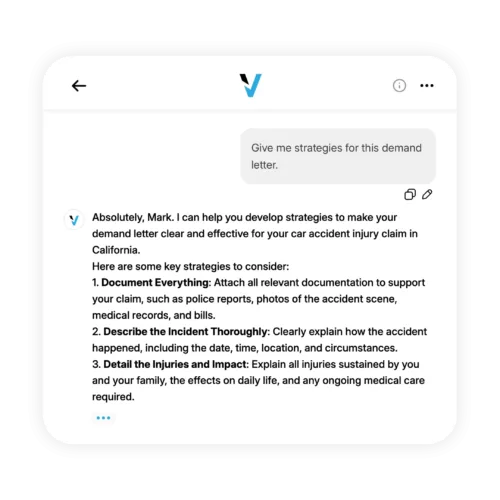
Strategy Mode:AI-Powered Legal Risk Assessment and What-If Planning
Most legal questions have a single clear answer: what does this clause mean, is this lawful, what is the deadline, what happens if I do nothing. Some legal situations do not. What is the best way to approach a dispute with a former business partner when you both have leverage? How should you structure a negotiation with your employer over severance after a layoff? What happens across three plausible scenarios if you refuse to sign a modified non-compete? These are not fact questions; they are strategy questions. Strategy Mode exists for them.
Strategy Mode activates a structured planning framework that walks you through risk assessment, what-if scenarios, and specific response planning. It is the feature most users reach for when they have already figured out the basic facts and now need help figuring out what to do about them.
When to Use Strategy Mode

When the decision is multi-step
If your matter requires a sequence of actions where each step depends on the previous outcome, Strategy Mode helps you plan the full sequence rather than treating each step as an isolated question.
When there are multiple plausible paths
When you could negotiate, litigate, ignore, or walk away, and the right path is not obvious, Strategy Mode evaluates each path against your specific goals, leverage, and constraints.
When leverage matters
Disputes, negotiations, and settlements often turn on leverage rather than strict legal rights. Strategy Mode explicitly considers what leverage each side has and how to use yours.
When you need to anticipate the other side
Strategy Mode walks through likely counter-moves. If you send a demand letter, how is the other side most likely to respond? What are their best options? What are yours in response to each?
Before a conversation with an attorney
Strategy Mode produces the kind of organized thinking that makes attorney consultations dramatically more efficient. Show up with a structured analysis, a list of options, and your priorities clarified, and the attorney can focus on judgment rather than intake.
How Strategy Mode Works
Step one: Define the situation and goal
Strategy Mode starts by getting clear on what you are trying to accomplish. Not "my partner is in breach," but "I want to end the partnership on terms that let me keep the client relationships I built, recover my capital contribution, and avoid litigation if possible."
Step two: Identify the decision points
Strategy Mode maps the key decisions you face. Send a demand letter first or go straight to litigation threat? Negotiate publicly or through counsel? Accept a partial resolution or hold out for full? Each decision point becomes a branch to analyze.
Step three: Assess leverage and risks
For each path, Strategy Mode evaluates your leverage (what you have that the other side wants or fears), their leverage (what they have that could hurt you), and the key risks on each side.
Step four: Run the scenarios
Strategy Mode walks through what-if scenarios: if you take path A, the likely outcomes are X, Y, and Z, with probabilities roughly ranked. If you take path B, different outcomes.
Step five: Recommend a plan
Based on your stated goals and the analysis, Strategy Mode recommends a specific sequence of actions, with contingencies for the most likely responses.
Example Strategy Mode Sessions
Example: Severance negotiation after a layoff
A marketing director is laid off after six years with a mid-sized tech company. The severance offer is four weeks of pay plus COBRA for two months, contingent on signing a release. Strategy Mode walks through: her likely leverage (knowledge of the layoff's timing relative to protected categories, her documented performance history, her industry network), the company's likely concerns (unemployment claims, bad Glassdoor reviews, potential age-discrimination concerns), realistic counter-offer ranges (typically 2-4x initial for her tenure and seniority), and a specific response sequence (request three specific items, signal willingness to sign with modifications, use a one-week response window to create urgency). She negotiates to 12 weeks of severance plus four months of COBRA. Time in Strategy Mode: 22 minutes. Net benefit: approximately $28,000 in additional compensation.
Example: Small business dispute with a vendor
A bakery owner has paid a contractor $8,400 for a kitchen equipment installation that is three months late and appears partially defective. Strategy Mode walks through: the specific remedies under her state's consumer protection law, the strategic implications of filing a small claims case versus continuing negotiation, the calculation of her damages (not just the $8,400 but also the lost revenue from delayed opening), the likely responses of the contractor and his likely constraints (he has other customers, he has a reputation to protect, he has limited legal resources), and a recommended approach that uses a formal demand letter with specific cure periods and a clear escalation path. The matter resolves via settlement of $6,700 and contractor completion within two weeks. Cost saved over litigation: thousands.
Example: Deciding whether to fight a non-compete
An engineer has received a new job offer from a competitor. His current employer's non-compete says 18 months, nationwide. He is in a state where non-competes are enforced only above an income threshold, and his compensation is near that threshold. Strategy Mode walks through: how close he is to the threshold, what discovery would show in litigation, what his current employer is likely to do (threaten, litigate, or accept), the consequences of each, the specific steps he can take to position favorably (taking leave during notice period, removing company IP from personal devices, declining to take team members), and a recommended sequence. He takes the new job, receives a warning letter from the old employer, responds with a Strategy Mode-drafted letter pointing out the enforceability issues, and the matter dies. He starts the new role with no litigation.
How Strategy Mode Differs from Normal Conversations
-
Structured rather than conversational:
Strategy Mode organizes the analysis into explicit steps rather than free-flowing dialogue. -
Multi-scenario rather than single-answer:
Strategy Mode explicitly considers multiple paths and their outcomes. -
Leverage-aware:
Strategy Mode thinks about negotiation and power dynamics, not just legal rights. -
Goal-oriented:
Strategy Mode starts from what you want to accomplish, not from the facts alone. -
Recommendation-oriented:
Strategy Mode ends with a specific recommended action plan, not just information.
Frequently Asked Questions
-
How do I activate Strategy Mode?
In any conversation, ask Vikk AI to "use Strategy Mode" or "help me plan this out" or "think through this with me." Vikk AI shifts into the structured planning framework for the rest of the conversation.
-
Does Strategy Mode cost more?
No. Strategy Mode is included on every plan, including Vikk Free. It counts against your plan's conversation allowance like any other conversation.
-
Can Strategy Mode recommendations be trusted for high-stakes decisions?
Strategy Mode gives you a structured analysis, not a guaranteed outcome. For high-stakes matters, we always recommend running the plan by a licensed attorney before executing. Strategy Mode makes those attorney consultations dramatically more productive.
-
Can I use Strategy Mode for business decisions, not just personal matters?
Yes. Small business owners, founders, and managers use Strategy Mode regularly for partner disputes, vendor negotiations, employment decisions, and other commercial matters. Business plans include team access to Strategy Mode.
-
What if my situation is genuinely unpredictable?
Strategy Mode is honest about uncertainty. Where outcomes depend on factors you cannot control or predict, Strategy Mode says so and helps you plan for multiple contingencies rather than betting on a single outcome.
-
Is Strategy Mode a substitute for an attorney?
For many everyday strategic decisions, yes. For high-stakes matters, it is a powerful preparation tool but not a substitute for representation. The Connect With a Legal Pro feature is available when the analysis points toward that next step.
Think through your situation with structure, not guesswork. Start free.
Are you a Lawyer? Connect with our Users!