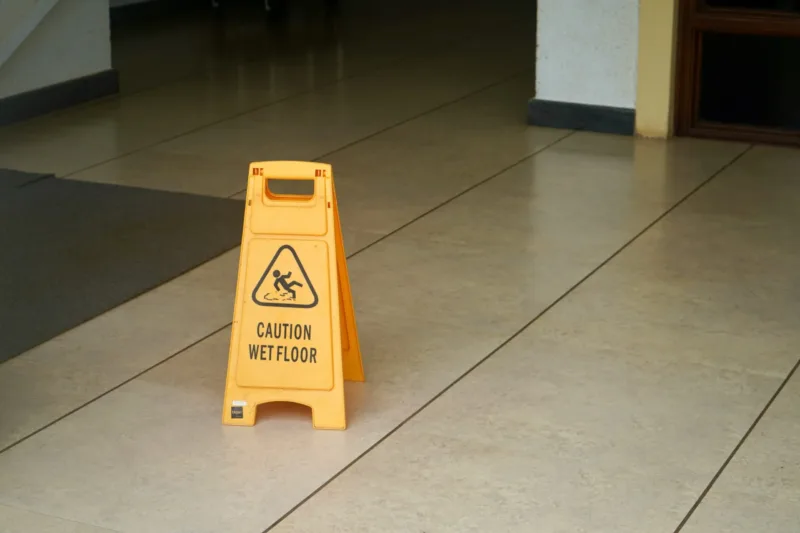
Slip and Fall Legal Help:Notice Requirements, Open and Obvious, and Establishing Property Owner Liability
Vikk AI provides instant slip and fall guidance for all 50 U.S. states. It explains the central notice requirement (actual and constructive), the open and obvious doctrine, common defenses, comparative negligence allegations, evidence preservation including video footage, common injury types, and prepares your demand letter and case strategy. Free to start. No credit card required.
Slip and fall is one of the most common types of premises liability cases but also one of the most difficult to prove.
Should the property owner have known? How long was the condition present? Could the plaintiff have avoided the condition through reasonable care? Slip and fall cases require careful evidence preservation because surveillance video, incident reports, and witness statements often disappear within days or weeks. The window for effective evidence preservation is narrow. Whether you have just been injured in a slip and fall, you are dealing with the property owner's insurance company, you are facing claims that the dangerous condition was 'open and obvious,' you are being blamed for not paying attention, or you are dealing with substantial injuries from a serious fall, Vikk AI is your always-available legal research, evidence preservation, and document drafting partner. For minor slip and fall cases (limited treatment, clear notice evidence), Vikk AI can often handle the entire matter without retained counsel. For more substantial cases (significant injuries, contested notice, complex defenses), specialized representation typically makes financial sense even after contingency fees. Ask any question about your fall, the notice requirements in your state, the open and obvious doctrine, comparative negligence allegations, available defenses, evidence preservation, and how to evaluate your case. Upload incident reports, medical records, photographs of the location and your injuries, and any other documents and Vikk AI analyzes everything in plain English. Draft demand letters, evidence preservation requests, and consultation preparation packages in minutes. When the case requires legal representation, Vikk AI suggests verified premises liability attorneys in your area or you can browse the directory yourself.
What does the plaintiff have to prove in a slip and fall case?
Slip and fall cases require proof of specific elements beyond simple injury on someone else's property.
Property owner owed plaintiff a duty of care. Duty depends on plaintiff's status: invitee (highest duty), licensee (medium duty), or trespasser (lowest duty). Most slip and fall cases involve invitees on commercial property.
Property had a dangerous condition: spilled liquid, wet floor, uneven surface, hidden hole, ice or snow, debris, etc. The condition must be the cause of the fall.
Property owner had notice of the condition. Two forms of notice: actual notice (owner knew about specific condition) or constructive notice (condition existed long enough that reasonable inspection would have discovered it). Notice is typically the most contested element.
Property owner failed to remedy the condition or warn invitees about it within a reasonable time after notice.
The dangerous condition caused the fall. Defendants often argue the plaintiff fell from another cause (existing medical condition, footwear, distraction).
The plaintiff suffered injuries from the fall. Documented through medical records and treatment.
What is actual vs constructive notice?
Notice is the central element in most slip and fall cases. Both forms can support liability.
- Actual notice
- Constructive notice
- Evidence of constructive notice
- Mode of operation theory
- Recurring condition theory
What is the open and obvious doctrine?
The open and obvious doctrine is a major defense to slip and fall claims. Property owners argue that obvious dangers do not require warning or remediation because plaintiffs should observe and avoid them.
If a danger is open and obvious, the property owner argues no liability for failure to warn. The plaintiff was responsible for observing and avoiding the obvious hazard.
The condition would be apparent to a reasonable person exercising due care. Visible obstacles, brightly marked construction zones, clearly wet floors with warning signs.
The doctrine has been weakened in many states. Courts increasingly recognize that property owners must remedy or warn of dangers even when they may be technically observable. The doctrine does not apply when: condition was distracting (plaintiff's attention was reasonably elsewhere), warning was inadequate, or remediation was reasonably possible.
Some states have abolished or significantly limited the doctrine. Others retain it broadly. Specific application varies by case facts.
Defendants regularly argue open and obvious as primary defense. Effective response: establish that condition was not actually obvious (lighting issues, similarity to surrounding area), establish reasonable distraction (signage, displays, other customers), establish that warning would have prevented fall.
Even when condition was somewhat obvious, comparative negligence may reduce rather than bar recovery. Plaintiff can argue they should have observed the condition but the property owner had primary responsibility to remedy it.
What are common slip and fall scenarios?
Specific scenarios produce most slip and fall cases.
- Spilled liquids in grocery stores
- Wet floors after cleaning
- Snow and ice accumulation
- Bathroom slips
- Defective stairs and steps
- Defective parking lot conditions
- Loose floor coverings
- Inadequate lighting
- Construction debris
What evidence is critical?
Slip and fall evidence preservation is time-sensitive. Surveillance video and other evidence often disappears within days.
Most commercial properties have surveillance cameras. Video typically shows: how the dangerous condition arose, how long it was present, who walked through the area, the fall itself, employee responses. Most retention is 30 to 90 days; some as little as 7 days. Immediate preservation request is essential.
Property owner typically creates incident report at time of fall. Get a copy. The report contains contemporaneous information valuable for case development.
Photos of the dangerous condition, the surrounding area, lighting, signage, your shoes, your injuries. Take immediately, before remediation. Multiple angles, with and without flash, showing scale (with reference object).
Other customers, employees, security personnel. Get names and phone numbers. Witnesses are often difficult to locate later if not identified at scene.
Property owner's inspection logs, cleaning schedules, maintenance records. Often subject to discovery once lawsuit is filed. May show pattern of inadequate inspection.
Preserve the shoes you were wearing. Defendants often argue inappropriate footwear caused the fall. Establishing reasonable footwear protects against this defense.
All medical treatment from initial care through ongoing therapy. Photograph injuries throughout recovery.
Records establishing your pre-fall condition (prior medical history, employment, physical activities). Defendants often argue pre-existing conditions caused or contributed to injuries.
What are common defenses to slip and fall claims?
Property owners and their insurance companies have specific defenses.
- Lack of notice
- Open and obvious
- Comparative negligence
- Pre-existing condition
- Storm in progress (snow/ice)
- Independent contractor
- Assumption of risk
- Statute of limitations
How Vikk AI Helps With Your Slip and Fall Case
Real Walkthrough:How a Customer Recovered $185K After a Grocery Store Slip and Fall Through Surveillance Video Preservation
A 52-year-old customer slipped on a grape lying on the floor of a major grocery store's produce section. She fell, fracturing her right wrist (requiring surgery and hardware) and tearing her right rotator cuff (requiring arthroscopic surgery). Medical bills exceeded $52,000; lost income $14,000; ongoing physical therapy projected to add $8,000. The store's insurance company initially offered $25,000 claiming lack of notice. Her attorney's investigation, supported by Vikk AI's research, ultimately produced a $185,000 settlement. She used a personal injury attorney on contingency at 33 percent and Vikk AI for case organization.

Step 1: Vikk AI helped with immediate evidence preservation
Within 48 hours of the fall, Vikk AI helped draft an evidence preservation letter to the grocery store demanding: surveillance video of the produce section for 4 hours before the fall, incident report, employee schedules and inspection logs, and identity of any employees in the area at the time. The letter put the store on notice that destruction of evidence would support adverse inference at trial. The store preserved 90 minutes of pre-fall video showing the area.
Step 2: Built constructive notice case from video
Surveillance video showed the grape on the floor for 47 minutes before the fall. During that time: 12 customers walked through the area without falling, 3 store employees walked past without picking up the grape, no inspection or cleaning was performed. The 47-minute duration substantially exceeded typical thresholds for constructive notice (30 minutes is often the threshold; less than 10 minutes is rarely sufficient).
Step 3: Documented mode of operation theory
The grocery store's produce section was self-service with grape and other small produce items. Vikk AI helped document the foreseeable hazard: customers selecting individual grapes routinely dropped or knocked grapes onto the floor. The store had a 30-minute inspection requirement in their internal procedures that they had not followed. Mode of operation theory plus failure to follow own procedures supported strong notice case.
Step 4: Demand letter and negotiation
Comprehensive demand letter for $295,000 with: detailed damages calculation ($72,000 economic + 3x multiplier for pain and suffering = $216,000 + 25% for permanent restrictions = $295,000), surveillance video evidence of 47-minute presence, mode of operation analysis, employee schedule showing inadequate inspection. The carrier responded with $65,000 offer. Through 4 rounds of negotiation over 5 months, settled at $185,000.
Step 5: Settlement breakdown
Settlement of $185,000. Less attorney's contingency at 33 percent ($61,050). Less reimbursement of advanced costs ($4,200 for medical record copies, expert review, deposition fees). Less health insurance subrogation (negotiated to $32,000 from $48,000 demanded). Net recovery: $87,750. The settlement covered all out-of-pocket medical costs, the lost wages, and provided meaningful compensation for the lasting wrist limitations and shoulder restrictions.
Total time: 11 months from fall to settlement. Total upfront cost: $0 (contingency-fee structure with costs advanced by attorney). Net recovery: $87,750. The case demonstrates the critical importance of immediate evidence preservation in slip and fall cases. Without the surveillance video preservation, the case likely would have settled at the initial $25,000 offer or less. The video establishing 47-minute notice period transformed the case from a difficult notice case into a strong constructive notice case with mode of operation support.
Why Vikk AI Is the Most Trusted AI Legal Assistant for This Topic
Built specifically for U.S. personal injury law, not retrofitted from a general chatbot
Generic AI tools like ChatGPT and Gemini frequently invent statutes that do not exist or apply the wrong state's rules to your situation. Vikk AI is purpose-built for U.S. personal injury law including state-by-state negligence rules, comparative fault systems, statutes of limitations, damages caps, and insurance frameworks.
Automatic state localization on every answer
You do not have to remember to mention your state. Vikk AI knows your jurisdiction from the start of your conversation and applies the correct comparative negligence rule, the correct statute of limitations, the correct damages framework, and the correct insurance requirements, automatically, on every question.
Privacy by default, with awareness of insurance company tactics
Your conversations about accidents, injuries, medical treatment, and damages are encrypted in transit and at rest. They are never sold, never shared with third parties, and never used to train any public AI model. Vikk AI also helps you understand how insurance companies use recorded statements, social media, and surveillance against injured claimants.
Honest about contingency fees and when retained representation is worth the percentage
Personal injury attorneys typically work on contingency (no fee unless you recover, then typically 33 to 40 percent of the settlement). For most serious injury cases, retained representation produces net recoveries substantially higher than DIY claims even after the contingency percentage. Vikk AI helps you evaluate when retained representation is worth the percentage and when it is not.


Frequently Asked Questions
-
What do I have to prove in a slip and fall case?
Five elements: (1) property owner owed you a duty of care, (2) there was a dangerous condition on the property, (3) property owner had notice of the condition (actual or constructive), (4) property owner failed to remedy or warn within reasonable time, (5) the condition caused your injuries.
-
What is the difference between actual and constructive notice?
Actual notice: property owner or employee actually knew about the specific condition. Constructive notice: condition existed long enough that reasonable inspection would have discovered it. Constructive notice is more commonly used because actual notice is harder to prove without specific evidence.
-
What is the open and obvious doctrine?
Defense argument that property owner is not liable for dangers that are obvious to reasonable people. Plaintiff should have observed and avoided. Doctrine has been weakened in many states; does not apply when condition was distracting, warning was inadequate, or remediation was reasonably possible.
-
Can I sue if I was at fault for the fall?
Depends on state. Pure comparative negligence states (California, others): you recover reduced by your fault percentage. Modified comparative (most states): you recover if your fault is below threshold. Pure contributory negligence states (Alabama, Maryland, North Carolina, Virginia, D.C.): any fault by plaintiff bars recovery entirely.
-
How do I prove how long the condition was present?
Surveillance video is the strongest evidence (preserve immediately). Other evidence: condition characteristics (dried liquid suggests longer duration), witness testimony, customer reports preceding the fall, employee inspection records. Constructive notice typically requires substantial time (30 minutes is often the threshold).
-
What evidence should I preserve?
Surveillance video (preserve immediately as retention is short), incident report, photographs of the dangerous condition and surrounding area, witness contact information, inspection records (subject to discovery), your footwear and clothing, all medical records.
-
What is mode of operation theory?
Some courts allow recovery without specific notice when the property's operation creates foreseeable dangerous conditions. Self-service grocery aisles are foreseeable to produce spills; failure to inspect frequently can support liability without proof of specific notice. Available in some states; rejected in others.
-
How much is a slip and fall worth?
Highly variable based on injury severity. Bruises and sprains: $10K-$50K. Wrist/ankle fractures: $25K-$100K. Hip fractures (often elderly): $100K-$500K+. Spinal surgery: $200K-$1M+. TBI: $100K-$5M+. Many cases limited by available insurance coverage and notice strength.
-
How long do I have to file a slip and fall claim?
Personal injury statute of limitations in your state. Common periods: 1 year (Kentucky, Tennessee, Louisiana), 2 years (California, Texas, majority), 3+ years (some states). Government claims have shorter notice periods. Missing the deadline almost always defeats the claim.
-
Should I see a doctor right away?
Yes, even if you feel fine. Adrenaline masks injuries. Many slip and fall injuries (TBI, soft tissue, spinal) are not immediately apparent. Medical examination in immediate aftermath is essential for both health and case purposes. Insurance companies use any delay to argue injuries are not real.
-
Can I use Vikk AI for the entire slip and fall case?
For minor cases (limited treatment, clear notice), often yes. For serious injuries, contested notice cases, or strong open and obvious defenses, hire an attorney to lead. The contingency percentage is typically far less than the recovery increase from professional representation.
Describe your situation. Get your state's rules in plain English. No credit card. 60 seconds to sign up.
Are you a Lawyer? Connect with our Users!