Motorcycle Accident Legal Help:Bias, Helmet Laws, Lane Splitting, and Catastrophic Injury Recovery
Vikk AI provides instant motorcycle accident guidance for all 50 U.S. states. It explains the anti-motorcycle bias that affects cases, helmet laws and their damages impact, lane splitting rules, common injury types, and prepares your demand letter and case strategy. Free to start. No credit card required.
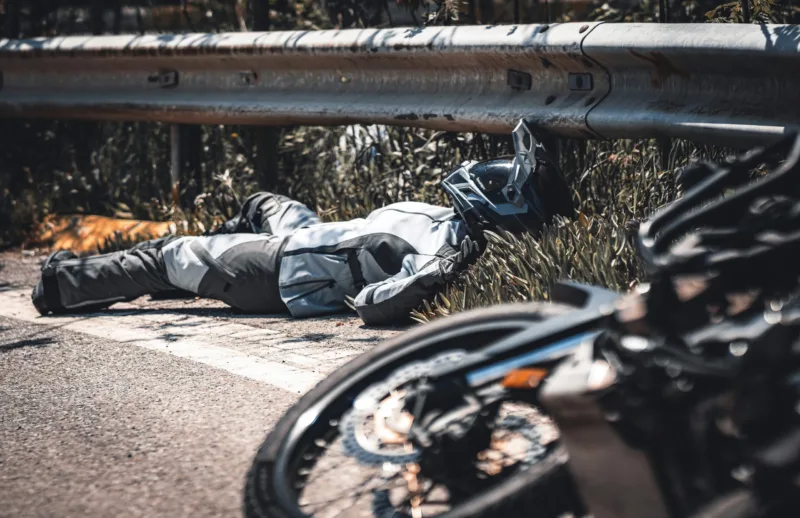
Motorcycle accidents have specific characteristics that distinguish them from car accidents and require specialized handling. Motorcyclists face anti-motorcycle bias from drivers, insurance companies, and sometimes juries, which substantially affects case outcomes. Helmet laws vary dramatically by state and create damages disputes when helmets were not worn. Lane splitting (legal in California, increasingly recognized elsewhere) creates specific liability disputes. Most importantly, motorcycle accidents typically produce more severe injuries than car accidents because riders have no airbags, no seatbelts, no crumple zones, and no enclosed structure protecting them.
Whether you have just been in a motorcycle accident, you are dealing with insurance company tactics that exploit anti-motorcycle bias, you are evaluating settlement offers that seem low for the injury severity, you are facing accusations of fault based on lane splitting or speed, or you are dealing with the long-term consequences of catastrophic injuries, Vikk AI is your always-available legal research, claim preparation, and document drafting partner. Vikk AI does not replace a personal injury attorney for motorcycle accident cases. The bias, the catastrophic injury severity, and the comparative negligence battles make specialized representation essential. What Vikk AI does is dramatically reduce what your attorney bills by handling research, document organization, and consultation preparation. Ask any question about your accident, anti-motorcycle bias and how to address it, helmet laws in your state, lane splitting rules, common injury types and their settlement ranges, evidence preservation, and how to evaluate offers. Upload accident reports, medical records, photographs, and any other documents and Vikk AI analyzes everything in plain English. Draft demand letters, claim documentation, and consultation preparation packages in minutes. When the case requires legal representation, Vikk AI suggests verified motorcycle accident attorneys in your area or you can browse the directory yourself.
What is anti-motorcycle bias and how does it affect cases?
Many people, including drivers, insurance adjusters, and jurors, hold negative views of motorcyclists as reckless or risk-taking. This bias substantially affects motorcycle accident outcomes.
Adjusters often assume the motorcyclist was at fault even when evidence shows otherwise. Initial offers are typically lower than equivalent car accidents. Adjusters point to motorcycle as inherently dangerous to argue for comparative negligence.
Studies consistently show motorcyclists receive less favorable jury verdicts than other plaintiffs with similar injuries and similar fault patterns. Jury selection in motorcycle cases is critical; defense attorneys try to identify and seat jurors with anti-motorcycle views.
Defendants regularly argue motorcyclists were speeding, weaving in traffic, splitting lanes inappropriately, or otherwise contributing to the accident. Even when these allegations are unsupported, they can affect jury views.
Effective motorcycle accident representation includes: emphasizing the driver's error rather than the motorcycle's existence, using accident reconstruction to establish exactly what occurred, presenting the motorcyclist as a responsible licensed motorcyclist (training, experience, equipment), and using voir dire to identify and remove biased jurors.
Cases are framed to emphasize universal driving rules (the driver violated right of way, the driver was distracted) rather than motorcycle-specific issues. The goal is to make the case about the driver's conduct rather than the motorcyclist's choice to ride.
What about lane splitting and lane filtering?
Lane splitting (riding between lanes of stopped or slow traffic) is one of the most controversial topics in motorcycle law. Legal status varies dramatically by state.
California is the only state that explicitly legalizes lane splitting (formally 'lane splitting' between lanes of moving traffic and 'lane filtering' between stopped traffic). The California Highway Patrol issues guidelines about safe lane splitting. Lane splitting accidents in California: the rider is generally not at fault simply for lane splitting.
Utah (legal between lanes of stopped traffic), Montana (legal between lanes), Arizona (legal under specific conditions). These states allow lane filtering at low speeds in stopped traffic but not lane splitting at higher speeds in moving traffic.
Most other states prohibit lane splitting and lane filtering. Riders who lane split in these states are typically considered at fault for accidents that result, even if the other driver also contributed.
Even in California, defendants often try to argue the lane splitting itself contributed to the accident (rider was traveling too fast, splitting in unsafe conditions). The CHP guidelines provide a framework for evaluating safe lane splitting, but specific facts determine liability.
Some insurance policies exclude lane splitting accidents. Specific policy language matters. Coverage disputes can complicate motorcycle accident cases.
What are common motorcycle accident scenarios?
Specific scenarios produce most motorcycle accidents. Understanding the scenario helps identify the responsible party.
- Left-turn collisions
- Lane changes into motorcycles
- Rear-end collisions of stopped motorcycles
- Door collisions
- Right-turn collisions
- Single-vehicle motorcycle accidents
- Highway speed accidents
- Intersection accidents
- Sudden lane change motorcycles
What evidence is critical in motorcycle accident cases?
Motorcycle cases depend heavily on specific evidence types.
- Helmet documentation
- Motorcycle documentation
- Witness accounts
- Surveillance video
- Accident reconstruction
- Driver's history and current condition
- Photographs of injuries
- Riding gear
How Vikk AI Helps With Your Motorcycle Accident Case
Ask: Get state-specific answers, 24/7, in plain English
Ask any question about your case. Examples: "How does anti-motorcycle bias affect insurance company offers?" "Will not wearing a helmet hurt my case in California's universal helmet law state?" "Is lane splitting legal in California under Cal. Veh. Code § 21658.1 and how does it affect liability?" "What is the typical settlement range for a motorcycle accident with TBI?" "How do I document the responsible-rider framing for my case?"
Upload: Have any document analyzed clause by clause
Upload accident reports, medical records, photographs of motorcycle and helmet, MSF training certificates, prior riding history documentation, and any other documents. Vikk AI builds the bias-counter framing and identifies all available coverage including umbrella policies.
Draft: Generate every document your case needs
Vikk AI drafts demand letters emphasizing universal driving rules rather than motorcycle-specific framing; responsible-rider documentation packages; accident reconstruction request memoranda; UM/UIM and umbrella claim documentation; consultation preparation packages for specialized motorcycle accident counsel; and translations of insurance correspondence and medical records into plain English.
Ready to start? Begin a free motorcycle accident conversation in 60 seconds, no credit card required.
Real Walkthrough:How a Motorcycle Rider Recovered $1.85M in a Left-Turn Collision Through Aggressive Bias-Counter Strategy
A licensed motorcycle rider with 15 years of experience was struck by a left-turning driver who failed to yield at an intersection. The rider was thrown from the motorcycle, suffering severe TBI, multiple broken bones (femur, tibia, three ribs), and serious road rash. Medical bills reached $385,000; future care projected at $750,000; lost income exceeding $400,000. The driver had $250,000 liability coverage; the rider had $250,000/$500,000 UIM coverage. Total available coverage: $500,000. The case settled for substantially more through specific bias-counter strategy. He retained a specialized motorcycle accident attorney on contingency at 40 percent and used Vikk AI for case organization.
Step 1: Vikk AI helped frame the case to counter bias
The attorney and Vikk AI developed a case theme emphasizing the universal driving rules rather than the motorcycle: the driver had violated right-of-way at the intersection (failed to yield to oncoming traffic before turning left). The case framing focused on the driver's distraction (texting at the time of the accident, supported by phone records), driver's prior accident history, and clear right-of-way violation. The motorcycle was incidental; any vehicle with right-of-way would have been similarly struck.
Step 2: Established the rider as a responsible motorcyclist
Vikk AI helped compile evidence supporting the responsible-rider framing: 15 years of motorcycle experience with no prior accidents, MSF (Motorcycle Safety Foundation) BasicRiderCourse and BasicRiderCourse2 completion, ABATE Member with ongoing safety training, DOT-approved full-face helmet (preserved as evidence), full protective riding gear (jacket, pants with armor, gloves, riding boots). The rider was framed as a careful, trained motorcyclist rather than a stereotype. This framing substantially affected jury appeal and insurance company evaluation.
Step 3: Accident reconstruction and physics
Hired accident reconstruction expert ($12,000) to establish: rider was traveling at speed limit at time of collision, rider had less than 2 seconds to react when driver began turning, no opportunity to avoid collision regardless of rider skill. The expert testimony directly countered any potential argument that rider speed or skill contributed.
Step 4: Multi-source recovery
Settlement against driver's $250,000 liability: full policy limit accepted. UIM claim against rider's own $250,000/$500,000 coverage: settled at $250,000 (full single-claimant limit). Total third-party plus UIM: $500,000. Then attorney pursued underinsured motorist excess from rider's umbrella policy ($1 million umbrella with motorcycle coverage). Umbrella claim settled at $1.35 million after 8 months of negotiation. Total recovery: $1.85 million.
Step 5: Settlement breakdown
Total recovery: $1.85 million. Less attorney's contingency at 40 percent ($740,000). Less reimbursement of advanced costs ($35,000 for accident reconstruction, life care plan, depositions). Less health insurance subrogation (negotiated to $145,000 from $290,000 demanded). Net recovery to client: $930,000 plus structured settlement of future medical care.
Total time: 22 months from accident to final settlement. Total upfront cost: $0 (contingency-fee structure with costs advanced by attorney). Net recovery: $930,000 plus structured future medical. The case demonstrates several key motorcycle accident lessons: (1) bias-counter framing is essential, (2) responsible-rider documentation supports both liability and damages, (3) accident reconstruction counters speed and conduct allegations, (4) all available coverage including umbrella must be pursued, and (5) catastrophic injury cases require specialized representation. The umbrella policy investigation alone added $1.35 million to the recovery.
Why Vikk AI Is the Most Trusted AI Legal Assistant for This Topic
Built specifically for U.S. personal injury law, not retrofitted from a general chatbot
Generic AI tools like ChatGPT and Gemini frequently invent statutes that do not exist or apply the wrong state's rules to your situation. Vikk AI is purpose-built for U.S. personal injury law including state-by-state negligence rules, comparative fault systems, statutes of limitations, damages caps, and insurance frameworks.
Automatic state localization on every answer
You do not have to remember to mention your state. Vikk AI knows your jurisdiction from the start of your conversation and applies the correct comparative negligence rule, the correct statute of limitations, the correct damages framework, and the correct insurance requirements, automatically, on every question.
Privacy by default, with awareness of insurance company tactics
Your conversations about accidents, injuries, medical treatment, and damages are encrypted in transit and at rest. They are never sold, never shared with third parties, and never used to train any public AI model. Vikk AI also helps you understand how insurance companies use recorded statements, social media, and surveillance against injured claimants.
Honest about contingency fees and when retained representation is worth the percentage
Personal injury attorneys typically work on contingency (no fee unless you recover, then typically 33 to 40 percent of the settlement). For most serious injury cases, retained representation produces net recoveries substantially higher than DIY claims even after the contingency percentage. Vikk AI helps you evaluate when retained representation is worth the percentage and when it is not.
Frequently Asked Questions
-
Why are motorcycle accidents different from car accidents?
More severe injuries (no airbags, no enclosure), anti-motorcycle bias from drivers/insurers/juries, helmet law impact on damages, lane splitting and lane filtering disputes, comparative negligence battles. Specialized representation is essential.
-
What is anti-motorcycle bias?
Negative views of motorcyclists as reckless or risk-taking held by drivers, insurance adjusters, and jurors. Substantially affects motorcycle accident outcomes through low initial offers, inflated comparative negligence allegations, and unfavorable jury verdicts. Effective representation counters bias through case framing and responsible-rider documentation.
-
Will not wearing a helmet hurt my case?
Depends on state. In universal helmet law states (California, New York, others), failing to wear can support 'helmet defense' reducing damages for helmet-preventable injuries. In partial law states, only riders subject to the law (typically under 21 or under 18) face this issue. In no-law states, helmet status is irrelevant. Helmet status does NOT affect liability for the underlying accident.
-
Where can I lane split legally?
California (under Cal. Veh. Code § 21658.1) is the only state that explicitly legalizes lane splitting. Utah, Montana, and Arizona allow lane filtering at low speeds. Most other states prohibit lane splitting; riders who lane split there are typically considered at fault for resulting accidents.
-
What is the most common motorcycle accident scenario?
Left-turn collisions: driver turning left fails to see oncoming motorcycle and turns into rider's path. Driver bears primary liability for failure to yield. Most successful motorcycle accident type for plaintiffs because right-of-way rules are clear.
-
How much is a motorcycle accident worth?
Highly variable based on injury severity. Soft tissue/road rash recovered: $10K-$50K. Surgery cases: $75K-$500K. Mild to moderate TBI: $200K-$2M. Severe TBI or spinal cord injury: $1M-$20M+. Many cases limited by policy limits rather than damages.
-
What evidence should I preserve?
Helmet (with damage documentation), motorcycle and damage photographs, witness contact information, surveillance video sources, photographs of riding gear, photographs of injuries throughout recovery, MSF training certificates and prior safety records.
-
Should I post about my motorcycle accident on social media?
No. Insurance companies routinely monitor social media for activities inconsistent with claimed injuries. Photos of you riding, exercising, or engaged in physical activities can damage your case. Avoid social media until the case is resolved.
-
What if the at-fault driver did not see me?
Common defense in motorcycle cases. Drivers claim they did not see the motorcycle. This is not a defense; drivers have a duty to look for all road users including motorcycles. 'Did not see' is actually evidence of negligence, not a defense. The defense is itself a basis for liability.
-
What if I had been drinking?
Substantial complication. Reduces or eliminates recovery in most states based on comparative negligence or contributory negligence. Even small amounts of alcohol affect the case. Attorney consultation is critical for any case involving alcohol use by the injured party.
-
Can I use Vikk AI for the entire motorcycle accident case?
No. Motorcycle accident cases require specialized attorney representation due to bias and catastrophic injury severity. What Vikk AI does is dramatically reduce attorney bills by handling research, document preparation, and case organization. Use Vikk AI alongside specialized motorcycle accident counsel.
Describe your situation. Get your state's rules in plain English. No credit card. 60 seconds to sign up.
Are you a Lawyer? Connect with our Users!