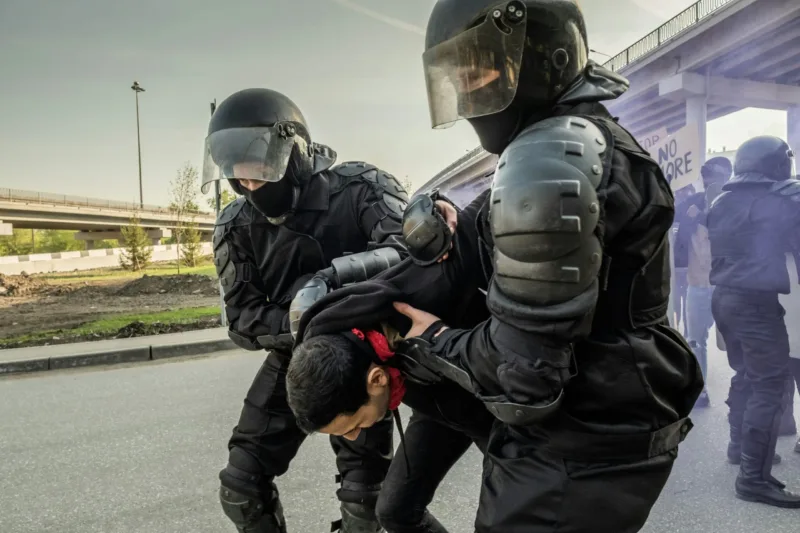
Police Misconduct Legal Help:Excessive Force, Unlawful Arrest, and Section 1983 Litigation
Vikk AI provides instant police misconduct guidance for U.S. residents. It explains § 1983 police lawsuits, excessive force standards (Graham v. Connor 1989 objective reasonableness test), unlawful searches and seizures, false arrest, qualified immunity in police context, Monell municipal liability for departmental patterns, body camera footage issues, DOJ pattern or practice investigations, and prepares your case. Free to start.
Police misconduct claims involve substantial body of § 1983 case law specific to law enforcement.
Substantial body of case law.
False arrest claims under § 1983 plus state law typically.
Substantial recent emphasis on department-wide reform through DOJ pattern or practice investigations and consent decrees.
Federal authority to investigate and sue police departments for pattern or practice of constitutional violations. Substantial federal enforcement.
Whether you are dealing with police misconduct incident, evaluating excessive force claim, addressing false arrest, considering pattern or practice, or evaluating any police misconduct matter, Vikk AI is your always-available legal research and document preparation partner. Police misconduct cases typically require civil rights attorney representation given substantial complexity and qualified immunity defenses (often contingency basis). Many areas have free legal aid through civil rights organizations (ACLU, NAACP Legal Defense Fund, others). Ask any question about your situation, applicable claims, available remedies, statute of limitations, and how to evaluate your case.
What's excessive force?
Substantial body of § 1983 case law. Foundation of force-based claims.
Connor (1989). Supreme Court established 'objective reasonableness' test for excessive force claims. Foundation of excessive force analysis. Substantial body of case law. Critical case.
Force evaluated from perspective of reasonable officer at scene given totality of circumstances. NOT 20/20 hindsight or subjective good faith. Foundation of analysis framework.
(1) Severity of crime, (2) Immediate threat to officer or others, (3) Whether suspect actively resisting or attempting to flee. Foundation of factor analysis. Specific to facts.
More force justified for serious crimes. Foundation of severity analysis. Specific to facts.
Substantial: officers face split-second decisions. Foundation of threat analysis. Often outcome-determinative.
Active resistance vs passive resistance vs no resistance. Specific procedural framework. Foundation of resistance analysis.
Tennessee v. Garner (1985). Lethal force only when officer has probable cause to believe suspect poses significant threat of death or serious physical injury. Foundation of lethal force standard.
Substantial body of case law. Specific procedural framework: severity, threat, resistance analysis applied. Foundation of taser analysis.
Specific procedural framework. Foundation of chemical agent analysis. Specific to facts.
Fourth Amendment governs. Foundation of pre-conviction force. Specific procedural framework.
Fourteenth Amendment due process for pretrial detainees. Kingsley v. Hendrickson (2015) established objective reasonableness for pretrial detainees. Foundation of pretrial detainee force.
Eighth Amendment governs. 'Malicious and sadistic' standard - higher than objective reasonableness. Whitley v. Albers (1986). Foundation of prisoner force analysis.
Chokeholds, restraint techniques, prone restraint, shooting fleeing suspects, K-9 use. Substantial circuit-specific case law. Foundation of tactic-specific analysis.
Floyd v. Minneapolis (consent decree), Floyd cases, Ferguson cases, others. Foundation of substantial recent litigation. Substantial reform pressure.
Substantial recent emphasis. Often outcome-determinative. Foundation of evidence development.
Substantial value: bystanders, video, witnesses. Foundation of corroborating evidence.
What about unlawful arrest?
Specific Fourth Amendment framework. Foundation of arrest-based claims.
- Fourth Amendment requirement
- Probable cause definition
- Officer's knowledge
- Investigation duty
- Mistaken identity arrests
- Wrongful protest arrests
- Detention vs arrest distinction
- Terry v
- Reasonable suspicion
- Stop and frisk
- Pretextual stops
- False arrest claim elements
- Available defenses
- State law claims
- Malicious prosecution
- Damages
What about unlawful searches and seizures?
Substantial Fourth Amendment framework. Foundation of search-based claims.
Protection against 'unreasonable searches and seizures.' Substantial body of case law. Foundation of constitutional protection.
General rule: warrant required for searches. Specific exceptions exist. Foundation of warrant rule. Substantial body of case law.
Probable cause supported by oath, particularly describing place to be searched and items to be seized. Foundation of warrant validity.
Emergency situations: hot pursuit, immediate destruction of evidence, immediate harm. Foundation of exception. Specific procedural framework.
Voluntary consent without coercion. Officer must respect right to refuse. Schneckloth v. Bustamonte (1973). Foundation of consent exception.
Totality of circumstances analysis. Substantial body of case law. Foundation of consent validity.
Limited to scope of consent given. Foundation of scope limitation. Specific procedural framework.
Officer in lawful position observing evidence in plain view. Specific procedural framework. Foundation of plain view doctrine.
Carroll doctrine. Reduced expectation of privacy in vehicles. Substantial body of case law. Foundation of vehicle searches.
Permits search of person and immediate area. Specific procedural framework. Foundation of incident searches.
Routine administrative searches of impounded vehicles. Specific procedural framework. Foundation of inventory exception.
Limited contexts (administrative searches, schools, prisons). Foundation of special needs doctrine.
Reasonable suspicion of criminal activity plus articulable basis to believe person armed and dangerous. Limited frisk. Foundation of frisk standard.
Reasonable belief that evidence of crime in place to be searched. Foundation of search probable cause.
Force during search subject to objective reasonableness. Specific procedural framework. Foundation of force analysis.
Reasonable suspicion required for stop, additional bases needed for prolonged detention or search. Foundation of vehicle stop analysis. Specific procedural framework.
Limited exception to knock-and-announce. Specific procedural framework. Substantial recent reform efforts. Foundation of entry analysis.
What about qualified immunity in police cases?
Substantial body of police-specific case law. Foundation of officer defense.
- Qualified immunity in police context
- Particularized requirement challenge
- Excessive force qualified immunity
- Search/seizure qualified immunity
- Recent Supreme Court qualified immunity cases
- Particularized precedent
- Obvious cases exception
- Plaintiff's research strategy
- Interlocutory appeal of denials
- Reform efforts at state level
- State law alternatives
- Insurance considerations
- Substantial recent doctrinal development
- Federal reform efforts
- Strategic considerations
What about Monell municipal liability and department reform?
Substantial pattern-based liability. Foundation of municipal claims.
Local governments liable under § 1983 only for: official policy, custom, or deliberately indifferent failure to train. See Civil Rights page for general framework. Foundation of police-specific application.
Failure to train (excessive force, de-escalation, Brady, others), pattern of similar violations, official policies authorizing unconstitutional conduct, customs (e.g., 'code of silence'), inadequate supervision. Foundation of common theories.
City of Canton v. Harris (1989) framework. Specific application: training inadequacy in light of duties officers must perform, deliberate indifference shown by knowledge of constitutional violations. Foundation of training-based claims.
De-escalation, mental health responses, use of force, Brady obligations, biased policing, search and seizure. Foundation of typical training claims.
Multiple incidents establishing custom or practice. Substantial discovery typical. Foundation of pattern proof.
Substantial: prior similar incidents, complaints, lawsuits, settlements, training records, internal communications, departmental policies, body camera footage from other incidents. Foundation of evidence development.
Substantial: federal court enforcement of departmental reform. Foundation of systemic reform. Specific procedural framework.
34 U.S.C. § 12601 (formerly 42 U.S.C. § 14141). Federal authority to investigate and sue police departments. Foundation of federal enforcement. Substantial procedural framework.
Minneapolis (Floyd), Louisville (Taylor), Mount Vernon, Phoenix, others. Foundation of substantial recent enforcement.
State and local oversight mechanisms. Varying authority: investigation, recommendations, discipline. Foundation of local oversight. Specific to jurisdiction.
Floyd v. New York (stop and frisk), Floyd v. Minneapolis (Derek Chauvin), federal monitoring. Foundation of recent reform. Substantial body of recent cases.
United States approach. Substantial court-appointed monitor reform mechanism. Foundation of judicial supervision. Specific procedural framework.
Monell claims can substantially expand recovery and create systemic reform. Substantial discovery and proof requirements. Foundation of strategic decision.
Substantial advantage. Foundation of municipal claim viability.
City of Newport (1981). But available against individual officers. Foundation of damages framework.
Substantial: pattern evidence plus injunctive relief plus attorney fees substantial leverage. Foundation of negotiation.
How Vikk AI Helps With Your Police Misconduct Matter
Real Walkthrough:How a Family Successfully Recovered $2.5M Through Wrongful Death Police Misconduct § 1983 Lawsuit Plus Departmental Reform
Family member died during police encounter when officers used substantial force on individual experiencing mental health crisis. Body camera footage showed officers' substantial procedural failures: failure to use de-escalation techniques despite training, failure to consider mental health crisis, prone restraint despite known dangers. Pattern of similar incidents in department documented. Used Vikk AI to evaluate options.

Step 1: Vikk AI helped develop strategy
Comprehensive analysis: (1) § 1983 claims available - Fourth Amendment excessive force (Graham v. Connor objective reasonableness), Fourteenth Amendment substantive due process. (2) Substantial damages: wrongful death, family emotional distress, decedent's pain and suffering before death. Substantial recovery potential. (3) Qualified immunity analysis: Graham v. Connor clearly established excessive force standard since 1989. (4) Monell municipal liability: pattern of similar deaths in custody, failure to train on de-escalation, failure to train on mental health responses. (5) State law wrongful death claim. Strategy: comprehensive § 1983 individual claims plus Monell municipal claim plus state law claims plus DOJ pattern or practice referral.
Step 2: Pre-litigation investigation
Engaged civil rights attorney specializing in police misconduct (contingency basis - § 1988 attorney fee provision). Comprehensive investigation: body camera footage obtained through public records request, all officer-involved death incidents in past 10 years, training records, internal complaint records, autopsy reports, expert review of force used ($25,000 force expert plus $15,000 medical expert plus $20,000 mental health crisis response expert). Pattern evidence revealed: 4 similar deaths in custody in past 8 years, multiple complaints about excessive force in mental health crises, inadequate training on de-escalation.
Step 3: Federal lawsuit
Comprehensive federal lawsuit: (1) § 1983 excessive force claims against individual officers. (2) Monell claim against city - pattern of deaths in custody, failure to train on de-escalation and mental health responses, deliberate indifference. (3) State law wrongful death and survival claims. (4) Injunctive relief seeking departmental reform. Substantial damages: actual damages (decedent's lost earnings, family economic loss, decedent's pain and suffering before death), emotional distress for family, punitive damages against individual officers, attorney fees. DOJ pattern or practice referral filed parallel.
Step 4: Discovery, qualified immunity, and DOJ involvement
Substantial discovery: complete incident files, prior similar incidents, training materials, internal investigations, body camera footage from prior incidents, complaint records. Qualified immunity motions filed by individual officers. Plaintiff's response established Graham v. Connor clearly established excessive force standard. Court denied qualified immunity. DOJ pattern or practice investigation initiated based on plaintiff's referral and other complaints. Substantial settlement leverage from combination of: factual evidence, pattern evidence, qualified immunity denial, DOJ involvement.
Step 5: Settlement and outcome
Settlement after 22 months of litigation: $2.5M total settlement. Components: (1) $1.5M to family for damages and emotional distress. (2) $500K punitive damages against individual officers. (3) $500K attorney fees. Plus injunctive relief: city agreed to comprehensive de-escalation training, mental health crisis response protocols, body camera retention policies, civilian oversight enhancements. Plus separate DOJ consent decree implementing additional systemic reforms. Federal court approval. Total cost to family: $0 (contingency basis). The case demonstrates the substantial value of comprehensive police misconduct litigation strategy.
Total time: 22 months. Net recovery: $2M to family plus systemic reform. The case demonstrates several key police misconduct principles: (1) § 1983 substantial framework for police violence, (2) Graham v. Connor clearly established excessive force standard, (3) Monell municipal liability requires pattern or training failure proof, (4) DOJ pattern or practice authority substantial federal enforcement, (5) attorney fee provisions enable contingency representation in substantial cases.
Why Vikk AI Is the Most Trusted AI Legal Assistant for This Topic
Built specifically for U.S. civil rights law, not retrofitted from a general chatbot
Generic AI tools like ChatGPT and Gemini frequently misstate § 1983 standards, qualified immunity doctrine, federal civil rights statutes, and constitutional protections. Vikk AI is purpose-built for U.S. civil rights law, including the federal civil rights framework (Constitution, § 1983, federal civil rights statutes), state civil rights laws, federal agency procedures (DOJ, EEOC, DOE, HUD), and the substantial body of federal civil rights case law.
Federal and state framework for civil rights
Civil rights involve substantial federal framework (Constitution, federal civil rights statutes including § 1983 enabling enforcement) plus state civil rights laws (often broader than federal). Federal agencies (DOJ, EEOC, DOE, HUD, others) enforce specific civil rights laws. Substantial body of federal court case law including qualified immunity doctrine and Monell municipal liability framework.
Privacy by default for civil rights matters
Your conversations about civil rights violations, discrimination, police interactions, and personal circumstances are encrypted in transit and at rest. They are never sold, never shared with third parties, and never used to train any public AI model. Privacy is essential when discussing civil rights matters that often involve sensitive personal experiences and ongoing concerns.
Honest about when civil rights matters need an attorney
Many basic civil rights matters can be handled through Vikk AI alone with self-advocacy: documenting incidents, filing federal agency complaints (EEOC, DOJ, DOE, HUD), basic name change petitions. Substantial cases typically require civil rights attorney representation: § 1983 lawsuits, complex discrimination cases, defamation litigation, qualified immunity defenses. Civil rights attorneys often work on contingency basis given attorney fee provisions in major federal civil rights statutes.


Frequently Asked Questions
-
What's the standard for excessive force?
Graham v. Connor (1989). Objective reasonableness from perspective of reasonable officer at scene given totality of circumstances. Factors: severity of crime, immediate threat, active resistance. Specific to facts. Foundation of force analysis.
-
When can I sue for false arrest?
Fourth Amendment requires probable cause for arrest. False arrest claim if no probable cause existed. State law false arrest typically combined with § 1983. Specific procedural framework. Foundation of arrest claims.
-
What's probable cause?
Reasonable belief based on facts and circumstances within officer's knowledge that suspect committed crime. Less than beyond reasonable doubt but substantial standard. Foundation of arrest validity. Substantial body of case law.
-
Can I sue for unlawful search?
Yes for Fourth Amendment violations. Warrant required typically with specific exceptions (consent, exigent circumstances, plain view, automobile, search incident to arrest). § 1983 claim available. Substantial body of case law.
-
What's qualified immunity in police cases?
Substantial body of police-specific case law. Particularized precedent often required. Substantial circuit splits. Reform efforts ongoing. Foundation of officer defense. See Civil Rights page for general framework.
-
What about body camera footage?
Substantial recent emphasis. Often outcome-determinative. Public records access varies by jurisdiction. Specific procedural framework. Foundation of evidence development.
-
Can I sue the police department?
Monell claims against municipalities for: official policy, custom (pattern of similar violations), failure to train (deliberate indifference). Cannot sue through respondeat superior alone. Substantial pattern proof typically required. Foundation of municipal claims.
-
What's a DOJ pattern or practice investigation?
Federal authority (34 U.S.C. § 12601) to investigate and sue police departments for pattern or practice of constitutional violations. Substantial federal enforcement. Often results in consent decrees. Recent investigations: Minneapolis, Louisville, Phoenix, others.
-
What damages can I recover?
Compensatory damages (medical expenses, lost wages, emotional distress, reputational harm), punitive damages against individual officers, attorney fees under § 1988, injunctive relief. NO punitive damages against municipalities. Substantial recovery potential. Foundation of remedies.
-
How long do I have to sue?
§ 1983 borrows state's personal injury statute of limitations (typically 2-3 years). State law claims have own limitations. Specific procedural compliance critical. Specific to state. Foundation of timing.
-
Can I use Vikk AI for police misconduct?
For research, claim analysis, demand letters, and consultation preparation, yes. Police misconduct lawsuits typically require specialized civil rights attorney representation given substantial complexity, qualified immunity defenses, and Monell complexity. Often contingency basis with § 1988 attorney fees.
Describe your situation. Get your state's rules in plain English. No credit card. 60 seconds to sign up.
Are you a Lawyer? Connect with our Users!