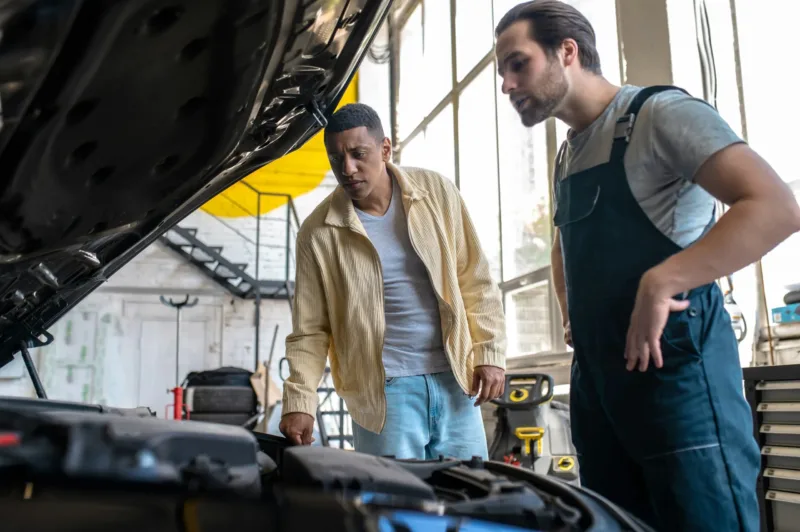
Lemon Law Legal Help:Defective Vehicles, Replacement, Refund, and Magnuson-Moss
Vikk AI provides instant lemon law guidance for U.S. vehicle owners. It explains state lemon laws (every state has version, with state variations), federal Magnuson-Moss Warranty Act supplement, qualifying defects (substantial defects affecting use, value, or safety), reasonable repair attempts standard, manufacturer remedies (replacement vehicle, refund, monetary settlement), arbitration procedures, lawsuit options, and prepares your case. Free to start.
Lemon laws protect vehicle consumers from defective vehicles. Every state has lemon law (substantial state variations) plus federal Magnuson-Moss Warranty Act provides supplement.
Specific procedural framework varies by state.
Whether you are dealing with defective vehicle, considering lemon law claim, evaluating arbitration vs lawsuit, addressing manufacturer dispute, or evaluating any lemon law matter, Vikk AI is your always-available legal research and document preparation partner. Many lemon law cases benefit from specialized lemon law attorney representation due to attorney fee provisions making representation economically viable. Many areas have free legal aid for low-income individuals. Ask any question about your situation, applicable claims, available remedies, statute of limitations, and how to evaluate your case.
What qualifies as a lemon under state law?
Specific procedural framework. State variations substantial.
Defect must substantially affect use, value, or safety of vehicle. Foundation of lemon law qualification. Specific factual analysis. Some states define more specifically.
Most states cover new passenger vehicles. Some states extend to: used vehicles (limited coverage), motorcycles, RVs, boats, leased vehicles. Specific to state.
Typically first year or first 12,000-18,000 miles (whichever first). Some states longer (California 18 months/18,000 miles, Florida 24 months). Specific to state.
Typical 3-4 unsuccessful repair attempts for same defect. Some states: 4 attempts standard. Others: 3 attempts. Specific to state. Foundation of repair attempt analysis.
Alternative: vehicle out of service for 30+ days (cumulative or consecutive depending on state) within coverage period. Foundation of alternative qualification.
May require fewer repair attempts (sometimes 1-2). Specific to state and defect. Foundation of safety priority.
Most states require written notice to manufacturer of defect (often via certified mail). Specific procedural compliance critical. Foundation of state-specific procedures.
Cal. Civ. Code § 1793.2. Substantial protection. Coverage period: 18 months or 18,000 miles (whichever first). Reasonable repair attempts: presumption after 4+ repair attempts or 30+ days out of service. Foundation of California protection.
Cal. Civ. Code § 1794. Allows lemon law claims for any consumer goods (not just vehicles). Substantial expansion. Foundation of California consumer goods protection.
F.S. § 681.10 et seq. Coverage period: 24 months from delivery. Reasonable repair attempts: presumption after 3+ repair attempts or 30+ days out of service. Mandatory pre-litigation arbitration. Substantial protection.
N.Y. Gen. Bus. Law § 198-a. Coverage period: 24 months or 18,000 miles. Reasonable repair attempts: 4+ attempts or 30+ days out of service. Substantial protection.
Texas Occupations Code Chapter 2301. Specific procedural framework. Substantial regulatory enforcement through Texas Department of Motor Vehicles.
Some states have used vehicle lemon laws: New York, Massachusetts, Connecticut, Rhode Island, others. Substantial state variation. Specific to state.
Most state lemon laws cover leased vehicles. Specific procedural framework. Foundation of lease consumer protection.
Federal warranty law supplements state lemon laws. Allows breach of warranty claims with attorney fees. Substantial supplement. Foundation of federal consumer remedy.
What documentation do I need?
Critical to lemon law success. Specific procedural framework.
- Purchase or lease documents
- Window sticker (Monroney label)
- Owner's manual
- Warranty documentation
- Every repair order
- Technician notes
- Specific defect descriptions
- Time out of service
- Loaner vehicle records
- Dealer communications
- Manufacturer communications
- Photographs and videos
- Witness testimony
- Expert evaluations
- Sales representations
- Recall information
What about Magnuson-Moss Warranty Act?
Federal warranty law supplementing state lemon laws.
Federal warranty law (15 U.S.C. § 2301 et seq.). Applies to consumer products with written warranties. Substantial supplement to state lemon laws. Foundation of federal consumer warranty remedy.
Consumer products with written warranties. Vehicles primary application but also: appliances, electronics, motorcycles, RVs, boats. Foundation of broad coverage.
Magnuson-Moss applies only to products with written warranties. If manufacturer provides written warranty, Magnuson-Moss applies. Foundation of warranty applicability.
Specific procedural requirements: free repairs, repairs within reasonable time, ability to elect refund or replacement after reasonable repair attempts, no consequential damages exclusions. Substantial protection.
Less stringent requirements. Most automotive warranties limited. Foundation of typical warranty.
If express warranty given, manufacturer cannot disclaim implied warranties. Substantial protection. Foundation of implied warranty preservation.
(1) Consumer product, (2) written warranty given, (3) breach of warranty (failure to repair), (4) damages. Foundation of federal warranty claim.
Actual damages plus attorney fees if prevailing plaintiff. Critical: attorney fee provision makes cases economically viable. Foundation of consumer access to representation.
Manufacturer can require informal dispute resolution before suit if program meets specific FTC requirements. Specific procedural compliance. Foundation of pre-litigation procedure.
Magnuson-Moss specifically preserves right to jury trial. Substantial procedural advantage. Foundation of jury access.
Most lemon law cases assert both state lemon law claim and Magnuson-Moss claim. Substantial procedural and substantive overlap. Foundation of comprehensive claim.
Specific to claim type. Generally 4 years from breach (UCC). Specific to state and warranty. Foundation of timing analysis.
Federal court jurisdiction generally requires $50,000+ in controversy individually. Most cases brought in state court. Specific procedural framework.
Federal Rule 23 class actions available for Magnuson-Moss claims. Foundation of mass enforcement. Specific procedural framework.
Reasonable attorney fees. Lodestar method (reasonable rate × reasonable hours) typical. Foundation of fee award. Substantial leverage in litigation.
What about arbitration and lawsuit options?
Multiple resolution paths. Specific procedural framework.
- Arbitration overview
- Manufacturer arbitration program
- BBB Auto Line
- Arbitration outcomes binding
- State-administered arbitration
- Arbitration consideration
- Arbitration when not required
- Lawsuit overview
- State court typical
- Federal court alternative
- Discovery
- Expert witnesses
- Trial
- Settlement
- Cost considerations
What remedies can I get?
Multiple remedy options. Specific to state and circumstances.
Substantially identical new vehicle. Foundation of equivalent replacement. Specific procedural framework. Often consumer's first choice for substantial defects.
Purchase price plus collateral charges minus reasonable allowance for use. Foundation of full reversal of purchase. Specific calculation per state.
Purchase price (excluding tax and registration in most states), plus: financing costs, sales tax (in some states), registration fees, license fees, dealer add-ons, options, accessories. Minus: reasonable allowance for use (typically miles driven at specific rate per mile).
Compensation to manufacturer for consumer's use. Specific calculation: typical formula (miles driven ÷ typical vehicle life) × purchase price. Foundation of fair use offset.
Compromise amount. Common in cases where defects don't fully meet replacement/refund standard but substantial. Foundation of negotiated resolution.
Settlement where consumer keeps vehicle plus receives cash compensation. Foundation of compromise resolution. Specific to circumstances.
Manufacturer agrees to repair beyond previous failed attempts. Foundation of preserved relationship. Specific to circumstances.
Settlement may include extended warranty. Foundation of consumer protection going forward. Specific to circumstances.
Most state lemon laws and Magnuson-Moss provide for prevailing plaintiff attorney fees. Substantial leverage. Foundation of consumer access to representation.
Court costs and litigation expenses. Foundation of cost recovery.
California Civil Code § 1794(c): up to twice actual damages for willful manufacturer violations. Substantial enhancement. Foundation of California penalty enhancement.
Available in some cases for fraudulent or malicious manufacturer conduct. Specific to state. Foundation of deterrent damages.
Some states allow recovery for time consumer unable to use vehicle. Foundation of additional damages. Specific to state.
Towing, transportation, rental car costs while vehicle in repair. Foundation of additional consumer expenses.
Lost wages from missed work, missed meetings, etc. Specific to circumstances. Foundation of indirect damages.
How Vikk AI Helps With Your Lemon Law Claim
Real Walkthrough:How a Consumer Successfully Recovered $32,800 Refund Plus Attorney Fees Through California Lemon Law
Consumer purchased new $32,000 SUV. After 8 months and 9,200 miles, consumer experienced: (1) transmission slipping (4 unsuccessful repair attempts), (2) engine warning light recurring (3 unsuccessful repair attempts), (3) total of 41 days vehicle out of service. Manufacturer refused buyback. Used Vikk AI to evaluate options.
Step 1: Vikk AI helped evaluate case
California lemon law analysis: (1) Coverage period - 18 months/18,000 miles (well within both). (2) Reasonable repair attempts - 4 transmission attempts plus 3 engine attempts (more than 4 total). California presumption of lemon after 4+ repair attempts. (3) Out of service days - 41 days exceeded 30-day threshold. Strong case under California Civil Code § 1793.2. Plus Magnuson-Moss federal supplement available. California Civil Code § 1794(c) allows civil penalties up to twice actual damages for willful violations - manufacturer's refusal to comply potentially willful given clear lemon law facts.
Step 2: Documentation and demand letter
Comprehensive documentation: every repair order with technician notes, communications with dealer and manufacturer, vehicle service history, photographs, witness statements. Engaged specialized lemon law attorney (no upfront cost - contingency basis with attorney fee shifting). Demand letter to manufacturer detailing California lemon law violations and demanding refund of $32,000 plus collateral charges plus attorney fees. Manufacturer's initial response inadequate (offered only repair, not refund).
Step 3: Arbitration
Manufacturer-sponsored BBB Auto Line arbitration scheduled. Consumer attorney prepared comprehensive presentation: documented defects, repair history, out-of-service days, manufacturer's failed repairs. Arbitrator's decision: lemon law violation found, recommended buyback at $32,800 (purchase price plus collateral charges minus reasonable allowance for 9,200 miles use). Manufacturer accepted arbitrator's decision (binding on manufacturer).
Step 4: Buyback completion
Manufacturer arranged buyback: consumer returned vehicle, received $32,800 refund. All collateral charges (sales tax, registration, license fees, dealer add-ons) included in refund. Mileage allowance calculated at standard formula (9,200 miles × $0.40/mile = $3,680 deducted from purchase price - actually less than $3,680 deduction because of collateral charges added back). Net refund: $32,800.
Step 5: Outcome
Buyback completed. Plus attorney fees of $4,800 paid by manufacturer (separate from buyback). Total time from initial dispute to buyback: 4 months. Total cost to consumer: $0 (contingency basis with attorney fee shifting). Compared to: continuing to drive defective vehicle could have resulted in: ongoing safety risks, continued repair costs, depreciation, frustration. The case demonstrates the substantial value of California lemon law plus attorney fee provisions making representation economically viable.
Total time: 4 months. Net recovery: $32,800 refund (plus elimination of defective vehicle ownership) plus $4,800 attorney fees paid by manufacturer. The case demonstrates several key lemon law principles: (1) repair attempt documentation foundation of claim, (2) attorney fee provisions critical for case viability, (3) California lemon law substantial state protection, (4) arbitration often effective resolution, (5) specialized lemon law attorneys typically work on contingency.
Why Vikk AI Is the Most Trusted AI Legal Assistant for This Topic
Built specifically for U.S. consumer protection law, not retrofitted from a general chatbot
Generic AI tools like ChatGPT and Gemini frequently misstate state-specific consumer protection statutes, FTC regulations, and procedural requirements. Vikk AI is purpose-built for U.S. consumer protection law, including the Federal Trade Commission Act, federal consumer protection statutes (FDCPA, FCRA, Magnuson-Moss, FCBA), state Unfair and Deceptive Acts and Practices (UDAP) statutes, and the specific procedural requirements that determine whether consumer protection claims succeed.
Automatic state localization on consumer protection rights
Consumer protection law involves substantial state variation: state UDAP statutes range from limited (some states) to expansive (California, Massachusetts, others), private rights of action vary, attorney general enforcement varies, damages provisions vary (single, double, treble), attorney fee provisions vary. Vikk AI knows your jurisdiction from the start of your conversation and applies the correct rules.
Privacy by default for consumer information
Your conversations about consumer disputes, financial information, identity theft incidents, fraud, and personal circumstances are encrypted in transit and at rest. They are never sold, never shared with third parties, and never used to train any public AI model. Privacy is essential when discussing consumer matters that often involve sensitive information.
Honest about when consumer matters need an attorney
Many consumer disputes can be handled through self-advocacy with proper guidance: chargeback disputes, basic FDCPA claims, simple warranty issues, FTC complaints. Complex cases (substantial damages, contested litigation, class actions, regulatory enforcement) typically require attorney representation. Vikk AI helps you understand when self-help is appropriate and when attorney representation is warranted.


Frequently Asked Questions
-
What qualifies as a lemon?
Generally: vehicle has substantial defect affecting use, value, or safety; manufacturer or authorized repair facility unable to fix after reasonable number of attempts (typical 3-4 attempts for same defect, or 30+ days out of service in coverage period). Specific to state.
-
How many repair attempts qualify?
Typical 3-4 unsuccessful repair attempts for same defect. California presumption: 4 attempts. Florida: 3 attempts. Some states: 2 attempts for safety defects. Alternative: 30+ days out of service. Specific to state. Foundation of qualification.
-
What's the coverage period?
Typically first year or first 12,000-18,000 miles (whichever first). California: 18 months/18,000 miles. Florida: 24 months. New York: 24 months/18,000 miles. Specific to state. Foundation of coverage.
-
What documentation do I need?
Critical: every repair order with date, mileage, complaint, work performed, parts replaced, time in shop. Plus: purchase contract, warranty documents, communications with dealer and manufacturer. Foundation of lemon law success.
-
What's the Magnuson-Moss Warranty Act?
Federal warranty law (15 U.S.C. § 2301 et seq.). Applies to consumer products with written warranties. Provides breach of warranty claims with attorney fee provision. Substantial supplement to state lemon laws. Foundation of federal consumer remedy.
-
What remedies can I get?
Replacement vehicle (substantially identical new), refund (purchase price plus collateral charges minus reasonable use allowance), monetary settlement, attorney fees. California: civil penalties up to twice actual damages for willful violations. Specific to state.
-
Should I do arbitration first?
Many states require manufacturer-sponsored arbitration before lawsuit (Florida, others). Some states optional. Arbitration often faster and consumer-friendly but limited remedies. Outcome binding on manufacturer (if consumer accepts) but not on consumer. Specific to state.
-
Do I need a lawyer?
Highly recommended. Lemon law attorneys typically work on contingency or attorney fee shifting (recovered from manufacturer if consumer prevails). Substantial benefit to consumer access. Specialized expertise valuable. Foundation of effective representation.
-
What about used vehicles?
Some states have used vehicle lemon laws: New York, Massachusetts, Connecticut, Rhode Island, others. Substantial state variation. Most state new vehicle lemon laws don't cover used. Magnuson-Moss may apply if manufacturer's warranty still in effect. Specific to state.
-
How long do I have?
Specific to state and warranty. Typical 4 years from breach (UCC). Magnuson-Moss: 4 years typical. Some state lemon law deadlines specific (e.g., must initiate within coverage period plus reasonable time after expiration). Specific procedural compliance.
-
Can I use Vikk AI for lemon law?
For research, qualification analysis, demand letter drafting, and consultation preparation, yes. For actual lemon law claims, specialized lemon law attorney representation strongly advisable (typically contingency basis with attorney fees from manufacturer if successful).
Describe your situation. Get your state's rules in plain English. No credit card. 60 seconds to sign up.
Are you a Lawyer? Connect with our Users!