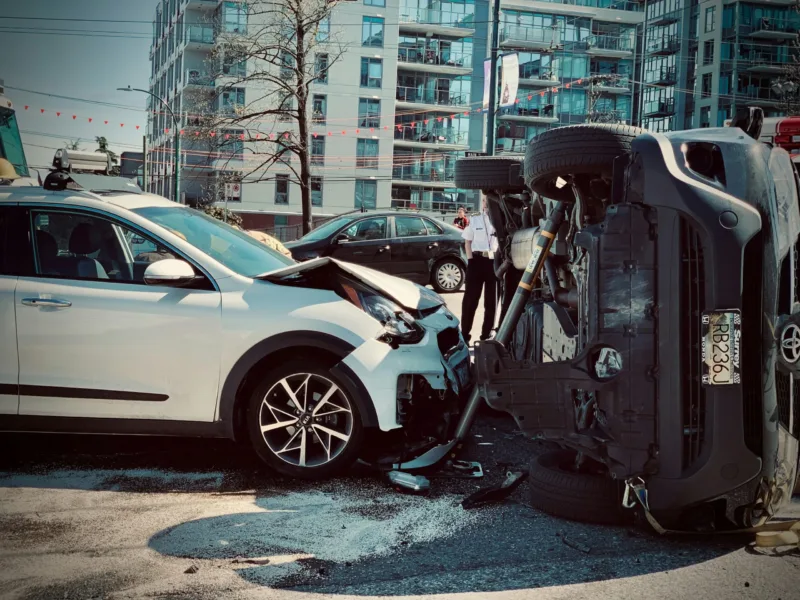
Injured in an Accident:Understand Your Rights, Preserve Your Claim, and Know When You Need a Lawyer
The first 48 hours after an accident are when the most important decisions get made, and usually when you are least prepared to make them. Insurance adjusters call within hours asking for recorded statements. Medical treatment decisions have legal consequences you don't know about yet. Evidence disappears. Statutes of limitation start running. Vikk AI is built to be your calm, knowledgeable first call. Describe what happened, in your own words, and get state-specific guidance on immediate steps, your rights, what to expect, and whether your situation needs a personal injury attorney or can be handled without one.
This page is unusual on the Vikk AI platform because most personal injury cases with significant damages (medical bills over $10,000, lost wages, serious long-term injury) do warrant a personal injury attorney, typically on contingency, meaning no fees unless you win. Vikk AI will tell you this honestly. What we offer is the preparation that makes the attorney consultation more productive, or, for smaller claims where an attorney isn't economical, the DIY path to a fair resolution with the insurance company.
Personal injury law is state-specific and often complex. Comparative negligence rules vary (some states bar recovery if you're 51% at fault, others allow reduced recovery at any percentage, a few use pure contributory negligence that bars recovery if you're even 1% at fault). Damages calculations depend on medical protocols, lost-income documentation, and pain-and-suffering formulas that vary by jurisdiction. Vikk AI applies the rules of your state.
Situations Vikk AI Handles
Motor vehicle accidents
- Car-on-car collisions: fault determination, comparative negligence, property damage claims, bodily injury claims, uninsured/underinsured motorist coverage, and how long you have to file.
- Pedestrian and cyclist injuries: driver liability, comparative fault, and specific legal protections for vulnerable road users.
- Rideshare accidents: Uber, Lyft, and similar involve three potential insurance coverages depending on driver status (personal policy, rideshare company's contingent coverage, rideshare company's full coverage).
- Motorcycle accidents: helmet laws, lane-splitting rules, and the unique challenges of motorcycle injury claims.
- Commercial truck accidents: federal motor carrier regulations, trucking company liability, and the enhanced documentation requirements.
Premises liability
- Slip and fall: business liability, residential property liability, and the knew-or-should-have-known standards.
- Negligent security: assaults and injuries on property where inadequate security was a cause.
- Dog bites: state-specific rules (strict liability vs. one-bite rule), homeowner's insurance implications.
- Swimming pool and amusement park injuries: specific state statutes and premises owner obligations.
Workplace injuries
- Workers' compensation: state-specific workers' comp processes, medical treatment rights, wage-replacement benefits, permanent disability ratings, and the exclusive-remedy rule.
- Third-party claims: when a non-employer third party caused or contributed to the workplace injury (defective equipment, negligent contractor), enabling a lawsuit outside the workers' comp system.
- Independent contractor injuries: how contractor status affects available remedies, and when that classification can be challenged.
Other personal injury
- Medical malpractice: standard of care, informed consent, and the specific procedural hurdles (certificate of merit, pre-suit notice) required in most states.
- Product liability: injuries caused by defective products, including cars, appliances, drugs, and consumer goods.
- Assault and battery: civil claims separate from criminal charges, including when the perpetrator is insured or has assets.


What to Do in the First 48 Hours (If You Haven't Yet)
-
Get medical attention, even if you think you're fine
Some injuries (concussions, soft-tissue damage) don't manifest for days. Medical records created immediately after the accident are critical to any later claim. -
Document everything
Photos of the scene, the vehicles or conditions, your injuries, and the witnesses' names and phone numbers. Write down exactly what happened while it's fresh. -
Do not give a recorded statement to any insurance company (including your own) until you've thought it through
You have a legal duty to cooperate with your own insurer, but you do not have to give a recorded statement on the first call. -
Do not sign anything the other party or their insurer puts in front of you
Settlement and release documents are permanent. -
Keep every receipt
Medical bills, prescription costs, mileage to appointments, missed work days, anything connected to the injury. -
Call Vikk AI, a legal aid hotline, or a personal injury attorney for guidance before talking to the other side's insurance adjuster.
A Real Walkthrough:Denver Commuter, Rear-End Collision, $18,000 Settlement
What Vikk AI walked her through
Step-by-step process for a Colorado soft-tissue injury claim: filing the claim with the at-fault driver's insurance (not her own, unless hers was a no-fault state, which Colorado isn't); documenting medical treatment through completion; calculating economic damages (medical bills, lost wages) and non-economic damages (pain and suffering) under Colorado's comparative-negligence rules; and the specific process for the demand letter and negotiation.
What the demand letter included
Total medical bills: $4,200. Lost wages from three appointments: $380. Mileage to appointments: $95. Pain and suffering calculated at 2x economic damages (typical for soft-tissue cases in Colorado with clean liability): $9,350. Total demand: $14,025, rounded up to a $16,000 opening ask to create negotiating room. Letter cited Colorado's comparative-negligence statute, documented the clear at-fault-driver liability, and attached medical records and wage documentation.
What happened
The insurer opened at $4,500. She countered at $14,000. The insurer went to $9,000. She went to $13,500 with a breakdown of each component. The insurer offered $11,500 and final. She accepted $12,500 after one more round. Total time: 11 weeks from accident to settlement, all done by email with Vikk AI drafting each response. Net to her after medical bills: approximately $8,000 in her pocket, plus payment of the medical bills directly.
When to Hire a Personal Injury Attorney Instead
Vikk AI handles most smaller personal injury claims well: clear liability, documented soft-tissue injury or minor injury, medical bills under roughly $15,000, no long-term impairment. For cases above that threshold, a personal injury attorney working on contingency almost always nets you more money, not less, because the insurer settles lower with unrepresented claimants and because experienced attorneys can identify damages categories (loss of earning capacity, future medical, consortium) that laypeople miss.
- Medical bills over $15,000



Frequently Asked Questions
-
How long do I have to file an injury claim?
Statutes of limitation vary by state and claim type. Most states have 2 or 3 years for general personal injury claims; some have shorter periods for specific claims (medical malpractice, claims against government entities). Some states have discovery rules that extend the period where the injury wasn't reasonably discoverable at the time. Vikk AI tells you your state's specific deadline.
-
Should I give a recorded statement to the other driver's insurance?
Typically, no. You have no legal obligation to give a recorded statement to the other party's insurer. Anything you say can be used to reduce your claim. It's usually better to stick to written communication, or to let an attorney handle all communication once you've retained one. Your own insurer is different: most policies require cooperation.
-
How much is my injury claim worth?
It depends on medical bills, lost wages, severity of injury, state law, and available insurance limits. For soft-tissue injuries with clear liability, claims often settle for 2-3x medical bills. For more serious injuries, multipliers can be higher but insurance policy limits often become the constraint. Vikk AI walks you through the specific calculation for your case.
-
What if the other driver was uninsured?
You'd look to your own uninsured motorist (UM) coverage, assuming you have it (it's mandatory in some states, optional in others). UM coverage essentially puts your own insurer in the shoes of the at-fault uninsured driver. Claims against your own insurer under UM coverage are subject to different procedural rules, including arbitration in some states.
-
Can I still recover if I was partly at fault?
In most states, yes, but the amount is reduced by your percentage of fault. In a few states (Alabama, Maryland, North Carolina, Virginia, and D.C.), any fault on your part can bar recovery entirely (pure contributory negligence). Vikk AI applies your state's specific rule.
-
What's the difference between a personal injury claim and a workers' comp claim?
Personal injury claims are based on fault (someone's negligence caused your injury) and can recover a broader range of damages (pain and suffering, full lost wages). Workers' comp claims are no-fault (you get benefits regardless of who was at fault) but typically cover only medical and a portion of lost wages, not pain and suffering. If injured at work, workers' comp is usually the exclusive remedy against your employer, but third parties may still be sued through personal injury.
-
Are pain and suffering damages real?
Yes. Non-economic damages (pain, suffering, loss of enjoyment of life) are real and legally recoverable in every state's personal injury system, though some states cap them. The calculation methods vary (multiplier of economic damages, per-diem, or jury determination). Insurance adjusters have internal formulas they use to value these, which Vikk AI can help you anticipate.
-
When should I accept a settlement offer?
When the offer reflects the realistic value of your claim after considering liability disputes, policy limits, and the time and cost of continued negotiation or litigation. Never accept a settlement while still undergoing active medical treatment, because you don't yet know the full extent of damages. Settlement releases are permanent: you cannot come back later for more money. Vikk AI helps you evaluate any specific offer against comparable outcomes.
Describe what happened. Get your state's answer and next steps, free.
Are you a Lawyer? Connect with our Users!