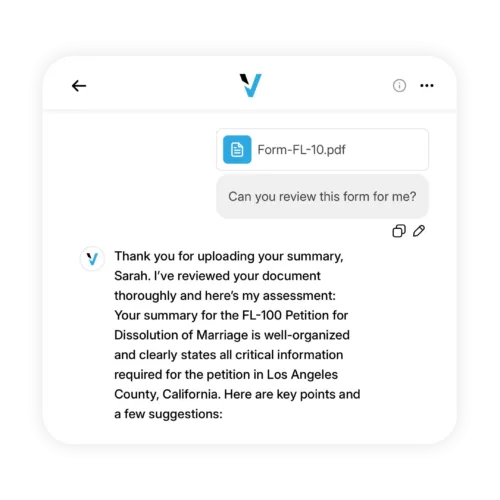
AI Document Upload and Analysis:Clause-by-Clause Review for Any Contract or Agreement
The single most useful thing Vikk AI does for most people is read a document they have been handed and tell them, in plain English, what is in it, what is risky, what is missing, and what to propose instead. Upload any PDF, DOCX, or pasted text (up to 300,000 words), and in under a minute you get a full clause-by-clause review with state-specific analysis, flagged risks, missing protections, and specific alternative language you can use in negotiation.
This is the feature that renters use on the lease they just signed, that new employees use on the offer letter they are about to sign, that freelancers use on the MSA a client sent last night, that founders use on the term sheet their investor proposed. It replaces the most common reason people pay lawyers: to read a document and tell them what it means.
What the Analysis Covers
Vikk AI reads the full document, not just headlines, and flags every clause that creates risk or needs attention. You get a structured breakdown: what the clause says in plain English, what the risk is, what state law says about enforceability, and what you might propose instead.
Every clause is evaluated against your specific state's law. A non-compete that is standard in Texas may be void in California. A liquidated damages clause that is enforceable in one state may be unconscionable in another. Vikk AI applies the law that will actually govern your situation, not the generic national default.
What is not in the document is often as important as what is. Vikk AI flags missing clauses you would typically want (limitation of liability, indemnification carve-outs, assignment restrictions, dispute resolution) and explains when they matter.
For every flagged clause, Vikk AI drafts redline-ready alternative language you can propose. This is not generic "consider asking for better terms." It is actual contract language in your state's style and consistent with your stated goals.
Deposit amounts, fee calculations, notice periods, deadlines, cure periods, automatic renewals. Vikk AI checks whether the numbers in the document comply with state law (for example, whether the security deposit exceeds the statutory cap) and whether the timing provisions match legal requirements.
Not every clause is equally important. Vikk AI ranks issues by severity so you know which to insist on changing versus which are minor.
Common Documents and What Vikk AI Catches
- Catches: illegal security deposit amounts, unenforceable early termination fees, improper entry provisions, missing habitability disclosures, unconscionable late fees, prohibited waivers of tenant rights, and automatic renewal traps.
- Catches: missing or overbroad personal guarantees, CAM charge ambiguities, exclusive use gaps, assignment restrictions that would trap you, holdover rent multipliers, and surrender conditions.
- Catches: overbroad non-competes (evaluated against your state's current rules), non-solicits without geographic or temporal limits, IP assignment clauses that claim pre-employment work, clawback provisions on signing bonuses, at-will disclaimers that contradict other provisions, and mandatory arbitration with one-sided terms.
- Catches: IP assignments that take your methodology, aggressive payment terms (net 60, net 90), limitations of liability that cap your damages but not theirs, broad indemnification running one way, choice-of-venue clauses pointing to remote jurisdictions.
- Catches: unreasonable confidentiality duration, overbroad definitions of confidential information, missing carve-outs for publicly available information, non-solicit piggy-backs, and reverse-engineering prohibitions that could trap routine work.
- Catches: releases that waive more than the specific claim at issue, non-disparagement clauses that chill legitimate speech, forum selection in a venue inconvenient to you, and tax-treatment language that could create unexpected liability.
- Catches: auto-renewal traps, price-increase clauses without notice, data-ownership ambiguities, indemnification gaps, service-level commitments that are effectively unenforceable, and termination-for-convenience rights running only to the vendor.
A Walkthrough
A software consultant receives a 14-page Master Services Agreement from a new enterprise client at 9am. The client wants a signed copy by end of week. She opens Vikk AI on her laptop at 9:17am, uploads the PDF, and types, "I am a solo consultant in Colorado doing a six-month project at about $200K total value. Please flag anything in this MSA I should push back on."
- IP Assignment (Section 7):
- Limitation of Liability (Section 11):
- Indemnification (Section 12):
- Non-Solicit (Section 15):
- Payment Terms (Section 4):
- Governing Law (Section 18):
Frequently Asked Questions
-
What document types work best?
Clean PDFs and DOCX files work perfectly. Scanned PDFs work well if the scan is legible. Photos of paper documents work via OCR but accuracy depends on lighting and focus. Pasted text works perfectly. If you have a document that is not analyzing well, try re-scanning at higher resolution or pasting the text directly.
-
Is my document private?
Yes. Uploaded documents are encrypted in transit and at rest. They are never used to train public AI models, never sold, and never shared with third parties. You can permanently delete documents from your account at any time.
-
Can Vikk AI review documents I did not write?
Yes. The most common use case is reviewing documents someone else sent you (a lease from a landlord, an offer from an employer, an MSA from a client). You do not need to have authored a document to upload it for analysis.
-
What if the document is in a language other than English?
Vikk AI supports documents in 30+ languages. You can upload a document in Spanish and ask questions in English, or vice versa. Cross-language analysis is built in.
-
How much does document analysis cost?
Document analysis is available on every plan, including Vikk Free. There is no per-document fee. Your plan's conversation limit is the only constraint.
-
Can I upload multiple documents at once?
Yes, and it is often useful. Upload a lease plus a move-in inspection plus a landlord deduction letter, and Vikk AI cross-references all three in the analysis.
Upload your first contract free. See what it actually says in sixty seconds.
Are you a Lawyer? Connect with our Users!