State-Specific Guidance:Legal AI That Knows Laws Change at the State Line
Most of U.S. law is state law. The rules for non-compete enforceability, security deposit returns, divorce procedure, eviction timing, debt collection, landlord entry, estate administration, and dozens of other everyday matters vary meaningfully from state to state. A generic legal answer that works in Florida may be wrong in California. A demand letter that cites the wrong state's statute is worse than no demand letter at all. Vikk AI is built to handle this correctly, automatically, without making you flag it every time.
This page explains how state-specific guidance works, what coverage looks like in practice, and why the state layer is treated as architectural rather than cosmetic at Vikk AI.
Why This Matters So Much
The same question gets different right answers in different states
Here are four examples out of many:
- Non-compete enforceability: California (Bus. & Prof. Code § 16600) voids most non-competes entirely. Minnesota, North Dakota, and Oklahoma have similar broad prohibitions. Washington, Colorado, Illinois, Oregon, Virginia, and a growing list of states enforce them only above income thresholds. Florida and Georgia enforce them with relative breadth subject to reasonableness. Getting the state wrong gets the answer wrong.
- Security deposit return deadlines: New York (14 days), California (21 days), Texas (30 days), Illinois (30-45 days depending on circumstances), Florida (15-60 days depending on dispute). Each state also has different penalty provisions for bad-faith withholding.
- Divorce residency requirements: From zero days (Washington, Alaska for military) to one year (Connecticut, Iowa, New Jersey, others). A person who files too early has their case dismissed and has to start over.
- Statute of limitations on debt: Three years in some states, six in many others, ten in a few. Old debts that are time-barred in one state may still be actionable in another, and the rules for restarting the clock differ everywhere.
Across the thousands of questions people actually ask about law, these state-level differences are not rare. They are the norm. An AI legal assistant that does not handle them correctly is not useful on the exact questions people most need answered.
How Vikk AI Handles State-Specific Guidance
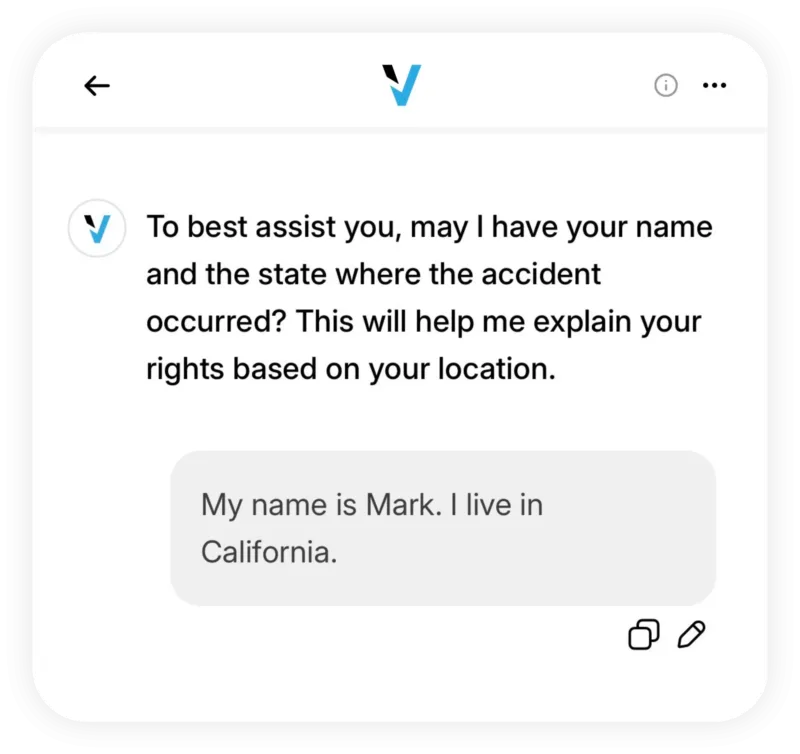
Your location is built into every response
Vikk AI asks for your state during onboarding (or detects it from your location with permission). Every answer, every document, and every risk assessment flows through that state filter. You do not have to remind Vikk AI which state you are in on every question.

County and city rules where they matter
Rent control is a municipal matter in many jurisdictions. Eviction notice periods, fair-housing coverage, and small-claims procedures vary at the county level. For matters where local rules are dispositive, Vikk AI surfaces the relevant county or city rules, not just state-level defaults.

Current statutes, updated on a rolling basis
Laws change. Minimum wages increase. Non-compete thresholds shift. Tenant protections expand. Vikk AI's legal knowledge is updated continuously as statutes change, and older training data is never treated as authoritative over a newer statute.
Uncertainty flagged when it matters
When a state's law is in flux (recently amended, subject to active litigation, or inconsistently interpreted by local courts), Vikk AI flags that uncertainty rather than pretending the answer is settled.
Coverage Across All 50 States
Vikk AI is trained on the statutes, codes, and major case law of every U.S. state plus the District of Columbia. That includes:
- Employment law: wage and hour, non-compete, at-will exceptions, whistleblower protections, state anti-discrimination statutes.
- Housing: tenant rights, security deposits, eviction procedures, rent control, habitability, landlord obligations.
- Family: divorce, custody, support, name changes, adoption, protective orders.
- Consumer: debt collection rules, statute of limitations, unfair practices, Lemon Law, warranty.
- Business: entity formation requirements, LLC rules, filing requirements, professional licensing.
- Estate: intestacy, will formalities, probate procedures, community property vs. common law.
- Personal injury: statute of limitations, comparative fault rules, damages caps.
- Traffic: moving violation penalties, point systems, traffic school eligibility.

West Coast and Pacific
California, Oregon, Washington, Nevada, Arizona, Hawaii, Alaska. California in particular has some of the most protective consumer, tenant, and employee rules in the country, and Vikk AI handles its complexity well.

Mountain West and Central
Montana, Idaho, Utah, Colorado, Wyoming, New Mexico, and the Great Plains states. Colorado has notable recent updates to non-compete rules; Vikk AI reflects current thresholds.

Midwest
Illinois, Michigan, Ohio, Indiana, Wisconsin, Minnesota, Iowa, Missouri, Kansas, Nebraska, and the Dakotas. Minnesota's non-compete ban is a recent significant change that Vikk AI applies correctly.

South
Texas, Florida, Georgia, North Carolina, South Carolina, Virginia, Tennessee, Kentucky, Alabama, Mississippi, Louisiana, Arkansas, Oklahoma, West Virginia. Louisiana's civil-law tradition (different from the common-law approach of the other 49 states) is handled appropriately.

Northeast
New York, Pennsylvania, New Jersey, Massachusetts, Connecticut, Rhode Island, Vermont, New Hampshire, Maine, Maryland, Delaware, and D.C. Massachusetts's tenant protections and New York's specialized rent control regimes are both handled with the specificity they require.

A Concrete Example
Two users ask Vikk AI the same question on the same day: "My landlord kept my entire security deposit for cleaning. Is that legal?"
User A in California gets an answer referencing Civil Code § 1950.5, explaining that general cleaning is not deductible unless the unit was left less clean than at move-in, that deduction letters for damage over $125 must include photographs, that the 21-day return window has specific requirements, and that bad-faith withholding triggers up to twice the deposit in statutory damages. The drafted demand letter cites the California statute.
User B in Georgia gets an answer referencing O.C.G.A. § 44-7-34, explaining Georgia's different rules, including the distinction between landlords with four or fewer rental units and those with more (which triggers different requirements), the 30-day return window, and Georgia's specific remedies. The drafted demand letter cites the Georgia statute.
Same underlying question. Different jurisdictions. Different right answers. Vikk AI gets this right without either user having to know the difference exists.
Frequently Asked Questions
-
How do I set or change my state?
During signup, you enter your state. You can change it in account settings at any time. If you are temporarily in a different state for a specific matter (like reviewing a contract governed by a different state's law), you can tell Vikk AI in the conversation.
-
Does Vikk AI handle laws that vary by city?
Yes, for matters where municipal rules apply. Rent control, short-term rental rules, and eviction procedures often vary at the city or county level, and Vikk AI incorporates those local rules when relevant.
-
What about matters that involve multiple states (for example, a contract governed by New York law but the user is in Texas)?
Vikk AI handles cross-jurisdictional matters explicitly. It explains which state's law governs which issue, when choice-of-law clauses are enforceable, and how to think about venue and forum-selection clauses.
-
How current is Vikk AI's state law knowledge?
Vikk AI's legal knowledge base is updated on a rolling basis. When a state passes a significant statutory change, that change is reflected in Vikk AI's responses as soon as the update is integrated. Where a law is recently changed and there is no established case law on the change, Vikk AI flags that uncertainty.
-
What if I live in a U.S. territory (Puerto Rico, Guam, USVI)?
Vikk AI has growing coverage for U.S. territories, though depth varies. For matters in Puerto Rico, USVI, Guam, American Samoa, or the Northern Mariana Islands, Vikk AI provides general guidance but may recommend local counsel more frequently than for the 50 states.
-
Is Vikk AI available for non-U.S. legal systems?
No. Vikk AI is specifically trained on U.S. law. For legal matters in other countries, we recommend local counsel or legal tools specific to those jurisdictions.
Get answers that respect the laws where you actually live. Start free.
Are you a Lawyer? Connect with our Users!